
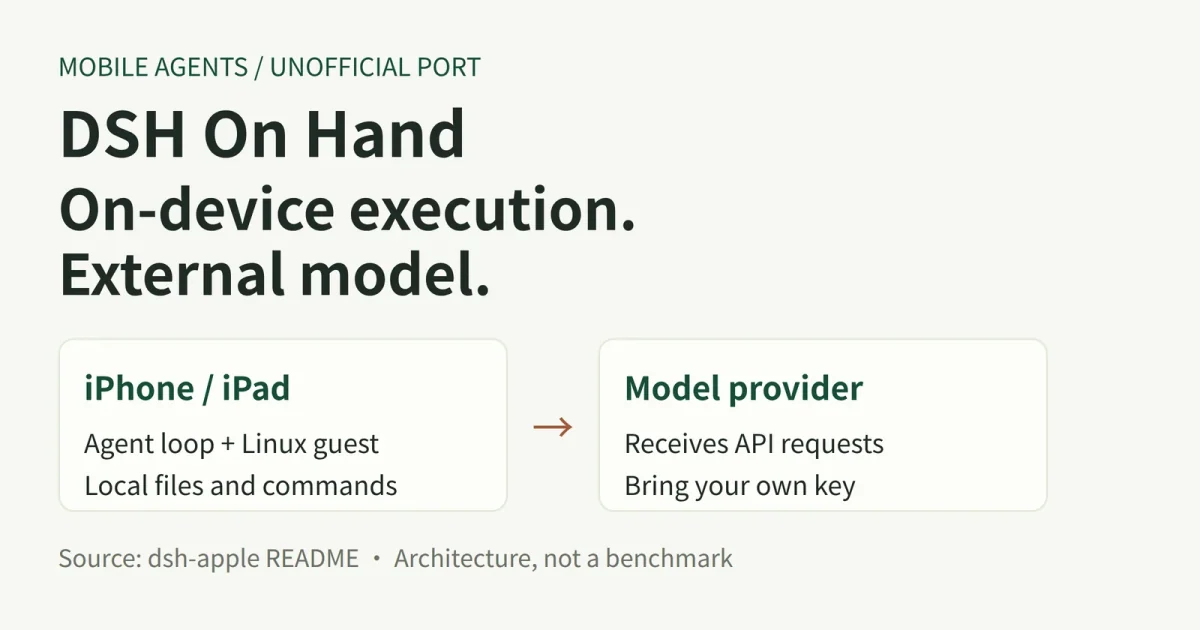
DSH On Hand offers mobile developers a way to execute an agent's commands without maintaining a remote computer. It does not remove the external model provider. That distinction defines the experiment: the device hosts the execution workflow, while model requests still travel to a service configured by the user.
The public beta listing describes DeepSeek Harness packaged for iPhone and iPad. The project is an unofficial port with no DeepSeek affiliation. Its commit history dates the initial public release to November 3. Further build synchronization and publication of the guest image's corresponding source appear on November 13. This is continued work on an experimental project, not a first open-source release today.
The addition is an agent workflow, not a mobile terminal
A Linux shell on an Apple mobile device is not new. The iSH project already describes a local Linux environment built with a usermode x86 emulator, including support for iPad. Someone who only needs a terminal can consider iSH without adding a model service.
DSH On Hand combines more components. Its architecture documentation describes a SwiftUI shell around the DSH web interface. Embedded nodejs-mobile runs the agent loop and web server, while a loopback channel passes commands to an Alpine environment in an iSH ARM64 guest. That guest description differs from the x86 approach on iSH's website; identical architecture or compatibility should not be assumed.
Our reading is that reducing dependence on a remote execution environment does not guarantee that data stays on the phone: model requests go directly from the device to the provider.
Execution is only part of the mobile problem
The README acknowledges that operating-system suspension can interrupt long tasks, and that iPad testing has been limited to a simulator. A mobile agent therefore needs more than a working conversation screen: it must preserve useful task state when the operating system takes away foreground time. The beta explicitly requests feedback about returning from the background, so this remains a validation question.
Distribution adds another obligation. The repository identifies the app as GPL-licensed and says recipients of TestFlight or App Store builds must be able to obtain complete corresponding source, including guest packages and image-building scripts. The README now locates the Alpine corresponding-source archive for the image shipped in builds 21 and 22 under Releases. That is specific progress, not proof that all distribution materials are complete. It also warns that passing build checks does not establish that the corresponding-source archive is complete. Those disclosures are not confirmation that distribution compliance has been finished.
The next useful evidence would be results for background recovery on physical devices, plus corresponding-source archives for other builds and complete distribution materials. A phone screen that can hold a conversation is not, by itself, proof of a mature mobile development environment.