
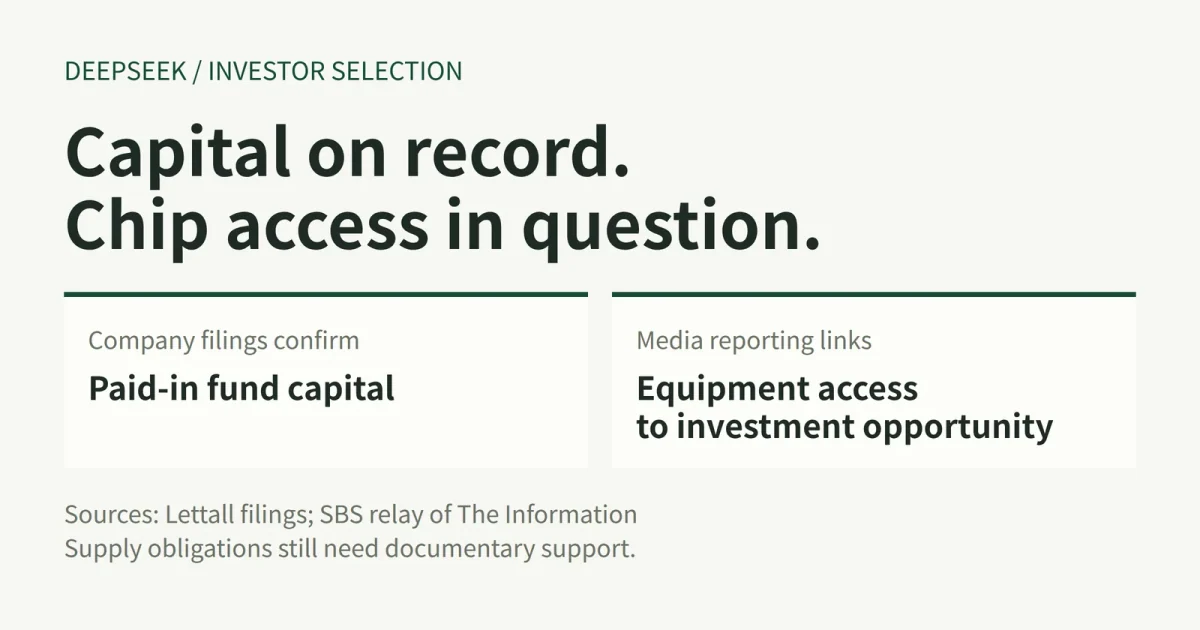
For anyone following AI financing, the interesting question is whether investors bring equipment access as well as money. On November 13, 2026, SBS relayed The Information's reporting linking investments in DeepSeek by companies associated with Alice Hwang to promises of Nvidia chips. The underlying report cites anonymous sources. It describes DeepSeek employees presenting Litong Group's ability to obtain Nvidia chips in bulk through the black market as a reason to give it an investment opportunity despite fierce competition.
The disclosures stop at the fund
Jiangsu LETTALL Electronic Co., Ltd provides a documented starting point. Its official profile matches that English name to the Chinese issuer named in the disclosures; SBS calls it Jiangsu Retal Electronics. Its September investment announcement described a subscription to the Lisi Xingshen fund. Contributions were to be in cash, and the fund could make direct or indirect equity investments in early- and mid-stage AI businesses.
An October update confirmed completed fundraising and paid-in commitments. That marks a progression from planned capital to contributed capital, not from promised hardware to accepted equipment. The disclosures did not name DeepSeek or present an accompanying chip purchase contract. A cash contribution does not establish a chips-for-equity exchange either.
Supply access may shape investor selection
Our reading is that the issue worth pursuing is not the personal connection itself, but whether compute supply became a condition in financing negotiations. The reported explanation by DeepSeek employees offers a specific lead: equipment access may affect who gets to invest, rather than simply what a model developer buys after raising money.
A conventional financial investment centers on valuation and returns. If access to equipment also enters the negotiation, a model developer may assess investors for supply certainty alongside capital. That is an inference from the reported arrangement, not a transaction term established by the filings. Whether the supply capability described by anonymous sources became a binding obligation still requires documentary support.
The indirect structure also deserves careful treatment. Permission for a fund to invest through intermediaries does not mean every contributor controls purchasing. Lettall's original announcement assigns investment decisions to the executive partner. Identifying the capital provider does not, by itself, identify the procurement decision-maker or the party responsible for delivering equipment.
The next useful evidence would be a disclosure naming the ultimate investment target, plus separate documentation of supply obligations and their fulfillment. Those records could distinguish equipment access used to make a persuasive investment pitch from equipment access written into the deal.