
Chinese localization for Antigravity is reaching Linux through a community fork. A new build appeared on November 14, 2026. For teams considering it as part of their working environment, the larger question is who will keep it compatible after the underlying application changes.
The release carries the v0.4.10 tag, with binaries for amd64 and arm64. Its repository identifies it as a fork of Antigravity-Hans. Describing that as full Linux support from the original project would erase an important distinction in maintenance responsibility.
Distribution has expanded; the documented commitment has not
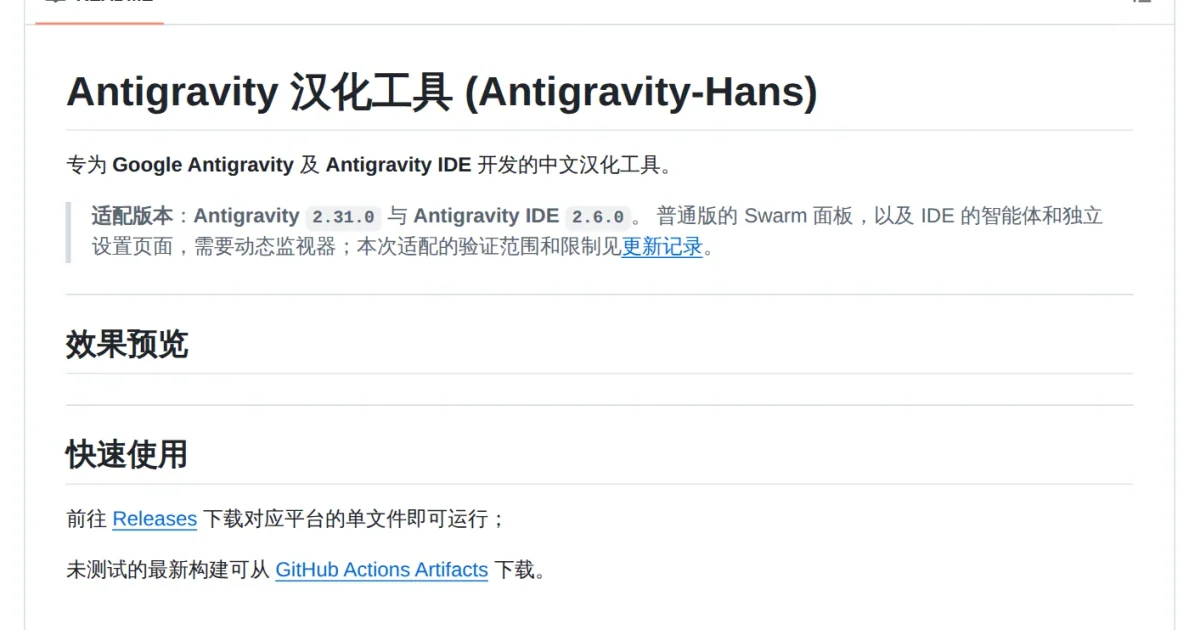
The fork retains instructions largely focused on Windows and macOS. Its short release note does not describe a Linux validation environment. The upstream README names Antigravity 2.31.0 and Antigravity IDE 2.6.0 as adaptation targets. Producing binaries does not, by itself, establish coverage across operating systems and application versions.
The upstream maintainer also warns that study commitments may delay updates and invites contributions to translations, version adaptations and fixes. Maintenance depends on continued contributions, not the act of publishing a release.
Our assessment is that a team considering a shared deployment should assess subsequent releases and issue handling, rather than merely count another operating system on the download list.
Permission labels make translation more than decoration
There is a more sensitive boundary than the number of translated strings. Upstream supports custom translation lists and explicitly warns that they can alter interface text about permissions. It advises using trusted lists.
Take Request Review, which the README renders in Chinese with the meaning 'request review.' Users still need to check the option against the original application's authorization behavior: the translated label alone cannot establish which actions will wait for review. The project offers a setting to retain English option names while leaving explanatory text in Chinese. It is off by default; enabling it provides a way to compare the original labels.
Translation accuracy can therefore influence how users interpret authorization choices. This is a risk assessment based on the documented feature, not a judgment that this particular translation is wrong. Changing interface wording does not itself change the underlying permission rules.
The next evidence to look for is a documented set of tested Linux environments, corresponding application versions and known limitations, along with a process for reporting and correcting ambiguous permission translations.