
Humata
ProductivitySearch, summarize and compare uploaded documents with source-linked answers. Humata adds team-oriented document access and page-based plans for ongoing knowledge work.
Questions across filesCited passages
A free OCR inference toolkit for developers who need to turn images into text, bounding boxes and confidence scores. RapidOCR packages recognition models with several runtime options and can run locally inside document-processing applications.
RapidOCR is an inference toolkit for integrating optical character recognition into software. It detects and recognizes text in images and exposes machine-readable results, making it useful when a developer needs OCR as one step in a larger pipeline rather than a separate desktop task.
The project builds on recognition models and supports multiple inference runtimes. It is related to the broader PaddleOCR ecosystem through model origins and conversion, while tools such as Umi-OCR can provide a graphical desktop layer. These are different roles: model ecosystem, inference engine and end-user application.
Index product screenshots
Prepare documents for retrieval
Build an internal review queue
Add OCR to a desktop utility
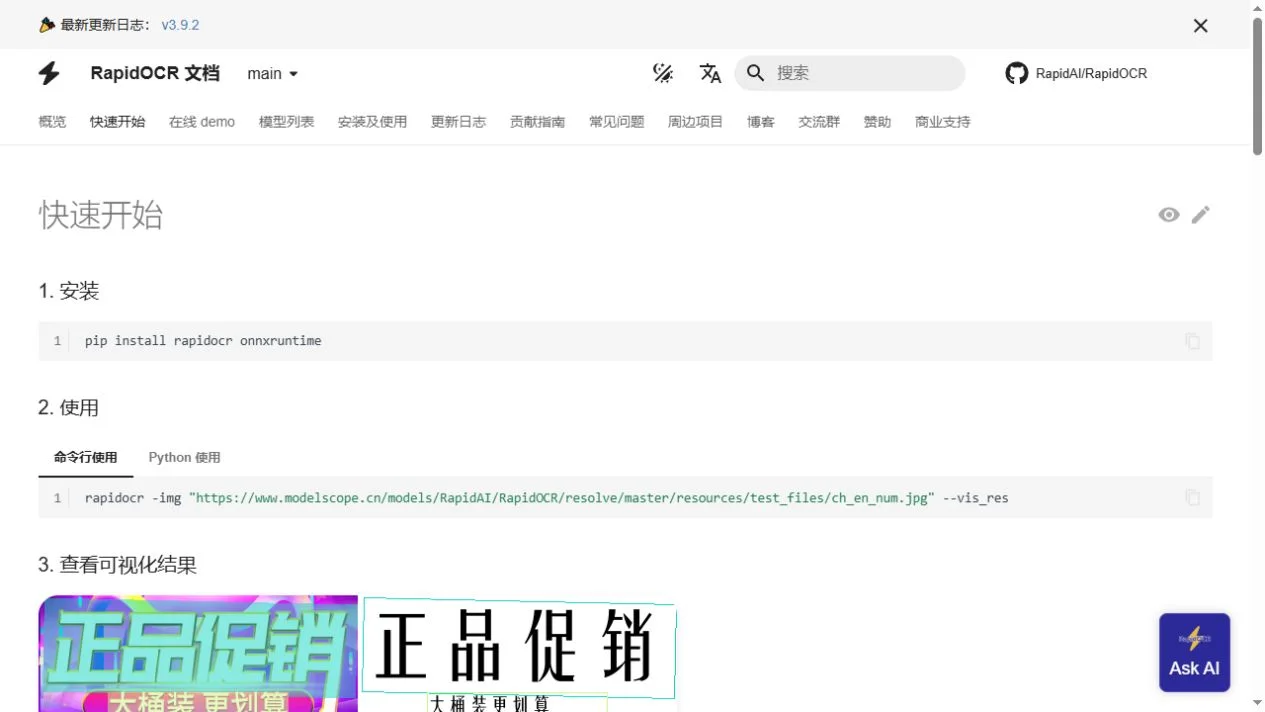
Official product image. Click to inspect the details.
Choose the target environment
Run the official sample
Evaluate your own material
Integrate with traceability
Example prompt or task: Build a local OCR step for image-only reference pages. Preserve page IDs, recognized text, bounding boxes and confidence values; route ambiguous numbers for human review before adding them to the searchable index.
This is an editorial starting workflow, not a measured performance result.
RapidOCR is open-source software under Apache-2.0. Running it locally does not require a hosted per-image OCR subscription, but compute, storage and any infrastructure used to serve requests remain the operator's responsibility.
RapidOCR is open-source software under Apache-2.0. Running it locally does not require a hosted per-image OCR subscription, but compute, storage and any infrastructure used to serve requests remain the operator's responsibility.
Check the licensing and distribution terms of the exact model files and dependencies used in an application. The toolkit's source license does not automatically replace the conditions attached to upstream models, fonts or optional components.
The source is available under Apache-2.0 for use according to that license.
Not necessarily. CPU-compatible runtime routes are documented.
Yes, when the needed runtime, models and other resources are already available locally.
Current documentation shows a result object containing boxes, texts, scores and related information.
Coverage depends on the selected recognition model, not simply the package name.
No. It is primarily a toolkit that applications can integrate; Umi-OCR supplies a user interface.
No. Validate important values against the source and the application's requirements.
Explore platforms, inputs and outputs, licensing, and access requirements.
The official installation guide covers platform and Python requirements and offers runtime-specific paths. A small CPU deployment and an accelerated server deployment may use different packages, model formats and resource settings.
OCR recognition is not the same as full document understanding. Multi-column reading order, table cells, formulas and handwritten notes can require additional processing. Keep the interface between OCR and later parsing explicit so each stage can be inspected independently.
A local deployment can keep recognition input within your own environment. If you expose it as a service, configure access control, input limits and log retention appropriate to the documents being processed.
Public demonstration images are examples, not evidence of performance on private business records. Evaluate with authorized samples and keep source documents available for correction instead of silently replacing them with recognized text.
Reviewed October 3, 2026. Product facts come from the official sources below. Suggested projects, prompts and review methods are FindGoodAI editorial guidance, not measured performance results.
Loading experiences…
Saved tools are private. Approved comments are public; edits return to moderation. Comment counts include approved comments and replies. Each person has one rating. New ratings are automatically approved; withdrawn, unapproved or invalid ratings do not count. Share real experiences and avoid spam, private information or personal attacks.
For moderation appeals or data requests: support@findgoodai.com
Bring a real task and see how it fits the way you work.
User experiences