
Humata
ProductivitySearch, summarize and compare uploaded documents with source-linked answers. Humata adds team-oriented document access and page-based plans for ongoing knowledge work.
Questions across filesCited passages
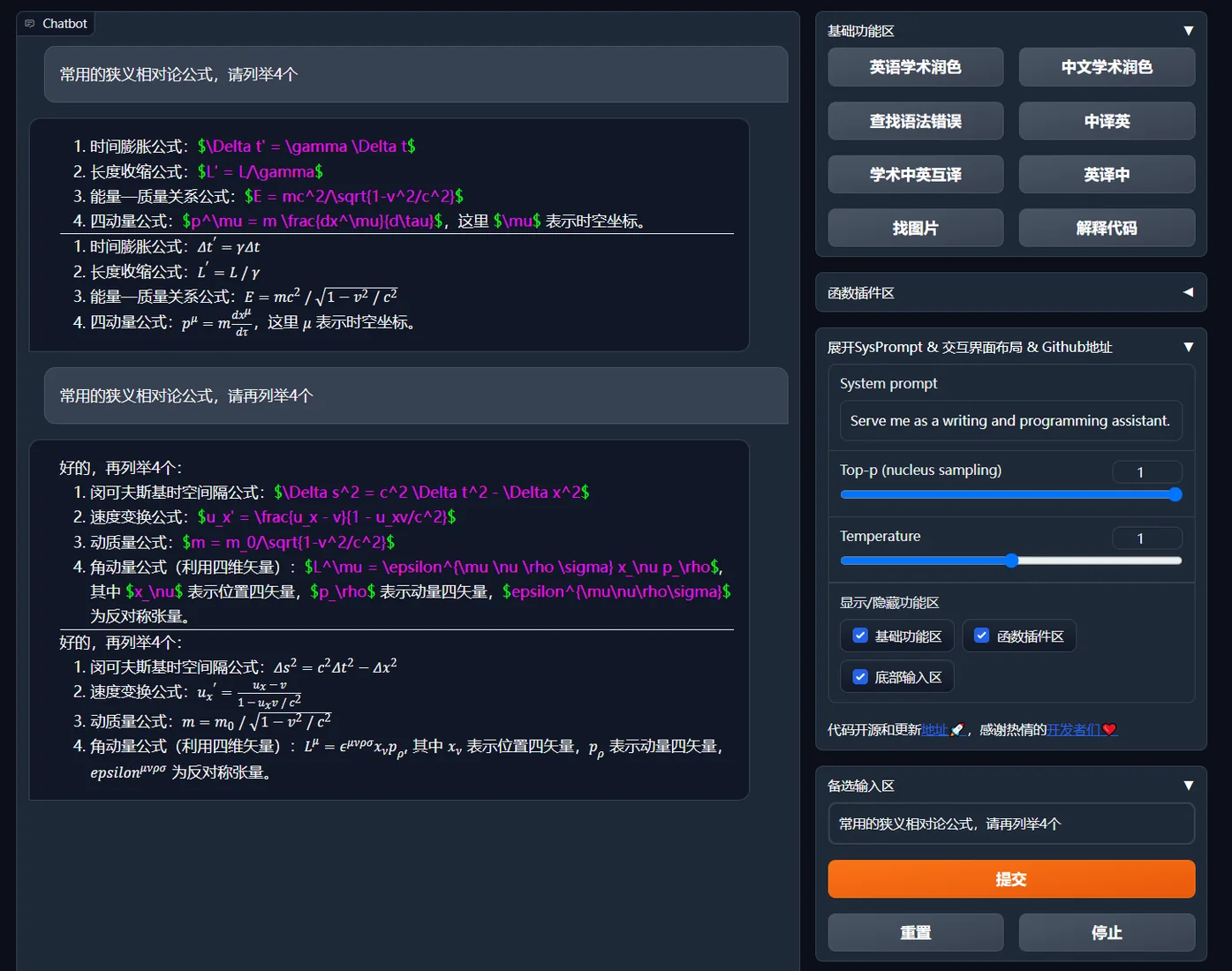
An open-source academic workspace for paper reading, translation, polishing and code explanation. GPT Academic combines configurable model connections with task-specific plugins, including PDF and LaTeX workflows, instead of relying only on a blank chat box.
GPT Academic is designed around the practical work surrounding research papers: reading, translating, checking language and explaining associated code. It offers a configurable interface and plugins that organize longer tasks into workflows, making it different from simply pasting an entire paper into an ordinary conversation.
The software connects to language models rather than including unlimited model inference. Users choose supported cloud providers or local routes and install the dependencies needed by their selected plugins. This is most useful for people willing to maintain a small research environment and review generated material carefully.
Read an unfamiliar paper
Prepare a bilingual paper draft
Polish a LaTeX submission
Understand research software
Official product image. Click to inspect the details.
Prepare an isolated environment
Connect a suitable model
Run one representative task
Review and retain source files
Example prompt or task: Explain this paper section in Chinese. Separate the authors’ claims, experimental evidence and your interpretation. Preserve symbols and units, list uncertain terminology, and do not invent missing citations or numerical results.
This is an editorial starting workflow, not a measured performance result.
GPT Academic is free software under GPL-3.0. Running the interface does not purchase model capacity, and cloud API calls can be billed by the configured provider. Local routes use the operator's hardware and require appropriate models.
GPT Academic is free software under GPL-3.0. Running the interface does not purchase model capacity, and cloud API calls can be billed by the configured provider. Local routes use the operator's hardware and require appropriate models.
Some plugins add external services or heavier dependencies. Estimate cost using a small representative document, and distinguish free source code from a hosted service, paid API allowance or support contract. There is no universal free token pool supplied by the repository.
The project is open-source under GPL-3.0.
Not necessarily. The selected provider controls API billing and limits.
The project documents local model and compatible service routes, with separate setup requirements.
It provides relevant plugins, but compilation and scientific meaning still require review.
Do not assume that. Image-only or complex PDFs may need preprocessing and extraction checks.
No. It assists research workflows and does not certify originality or scientific validity.
Review the GPL-3.0 obligations and the licenses of included dependencies before distribution.
Explore platforms, inputs and outputs, licensing, and access requirements.
The project provides Python and container-oriented installation routes with configuration and plugin documentation in its wiki. Different tasks need different components: a plain text rewrite and a LaTeX translation project do not have identical environment requirements.
Model lists and tutorials can reflect the period in which they were written. Use the current provider documentation and project configuration for an active model, rather than assuming every historical model name in an example is still available.
Determine where the configured model receives document text before processing unpublished papers or internal code. Use an approved local route or an authorized provider when the material cannot be sent to a public service.
Keep API credentials out of shared prompts, screenshots and repository commits. Generated summaries and translations should remain traceable to their originals; verify citations and preserve authorship rather than treating fluent output as newly established evidence.
Reviewed October 3, 2026. Product facts come from the official sources below. Suggested projects, prompts and review methods are FindGoodAI editorial guidance, not measured performance results.
Loading experiences…
Saved tools are private. Approved comments are public; edits return to moderation. Comment counts include approved comments and replies. Each person has one rating. New ratings are automatically approved; withdrawn, unapproved or invalid ratings do not count. Share real experiences and avoid spam, private information or personal attacks.
For moderation appeals or data requests: support@findgoodai.com
Bring a real task and see how it fits the way you work.
User experiences