
Humata
ProductivitySearch, summarize and compare uploaded documents with source-linked answers. Humata adds team-oriented document access and page-based plans for ongoing knowledge work.
Questions across filesCited passages
An open-source research-and-writing system that gathers sources, develops an outline and drafts cited articles. It is useful for pre-writing and topic exploration, with model and search costs separate from the free software.
STORM is a research system for producing Wikipedia-style article drafts from a topic. It separates source gathering and outline development from the writing stage, making it relevant when you need to understand what a topic contains before deciding how to explain it.
The project explicitly says its output is not publication-ready. That is a useful expectation: the generated draft is a map of questions and material to inspect, not a finished authority. A strong workflow keeps the sources visible, revises the outline and checks whether each important claim is actually supported.
An unfamiliar topic briefing
An editorial pre-writing packet
A research-method demonstration
An internal knowledge prototype
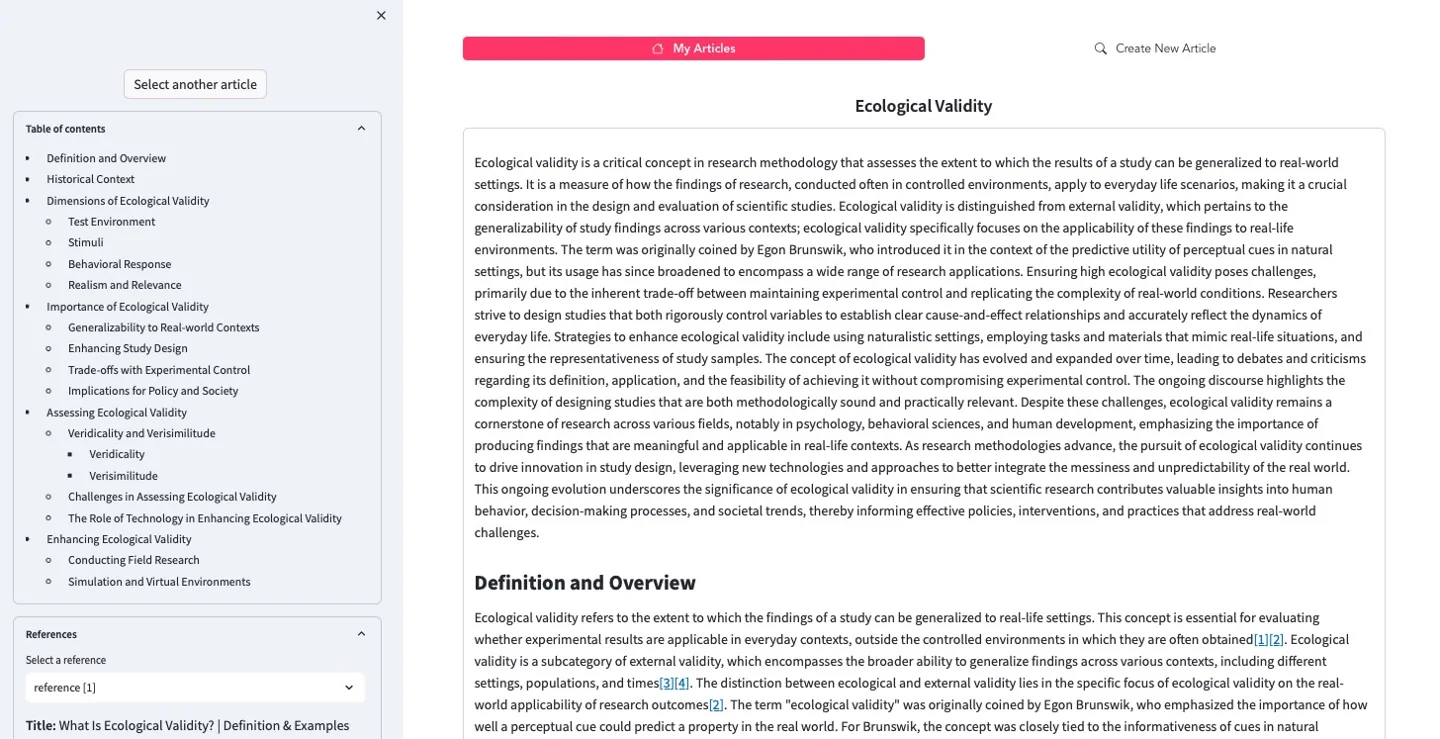
Official product image. Click to inspect the details.
Define the question and reader
Configure models and retrieval
Review evidence and outline
Edit and verify the final draft
Example prompt or task: Research how small teams can maintain an internal technical knowledge base. Cover information ownership, update routines and retrieval limits; separate documented facts from recommendations and preserve the source for each key claim.
This is an example topic brief. The configured STORM pipeline determines how the topic and additional guidance are supplied.
A public research preview is not a guarantee of unlimited hosted capacity. Self-hosting still needs configured model and retrieval services.
The project is MIT-licensed software, so downloading and self-hosting the code does not require a software subscription. Running it still needs language models and retrieval; hosted model calls, search APIs, embeddings, vector storage or infrastructure can incur charges.
The repository includes open-weight and custom-corpus examples, but a local configuration consumes hardware and requires setup. Public research-preview availability is separate from operating your own instance. Set a practical budget before using many perspectives or repeated full-length article runs.
Yes. The project uses the MIT license.
No. Inference, retrieval and hosting are separate.
The project says they generally need substantial editing.
Yes. The examples include a vector-retrieval path for a custom corpus.
Yes. The project provides an example, with setup and hardware requirements.
No. Read the cited material and verify the connection.
No. Treat research-preview access separately from a maintained deployment.
Explore platforms, inputs and outputs, licensing, and access requirements.
The Python package is named knowledge-storm. The repository documents separate research, outline, article and polishing stages, along with a minimal Streamlit interface. That interface displays intermediate progress and places an article alongside its references, which helps an editor revisit evidence.
For reproducible exploration, save the topic, model choices, retriever settings and source collection with the draft. Search results and model behavior can change over time. If an article appears comprehensive, still ask what the retrieval process failed to find and which sources were overrepresented.
A research topic can itself reveal a confidential plan. A self-hosted interface may still send queries and passages to external models or search providers, so map that route before using internal material.
The software license does not grant rights to every retrieved article or dataset. Retain source attribution and respect the terms of source material. When publishing, use your own analysis and concise supported summaries rather than reproducing long passages collected by the system.
Reviewed October 3, 2026. Product facts come from the official sources below. Suggested projects, prompts and review methods are FindGoodAI editorial guidance, not measured performance results.
Loading experiences…
Saved tools are private. Approved comments are public; edits return to moderation. Comment counts include approved comments and replies. Each person has one rating. New ratings are automatically approved; withdrawn, unapproved or invalid ratings do not count. Share real experiences and avoid spam, private information or personal attacks.
For moderation appeals or data requests: support@findgoodai.com
Bring a real task and see how it fits the way you work.
User experiences