JetBrains Junie
CodingJunie combines a coding agent with planning, model choice and JetBrains development workflows. Use the CLI, supported IDE integration or repository automation to work on scoped code changes.
An open-source control center for coding agents, conversations and automations, with local or remote execution backends and an explicit self-hosted route.
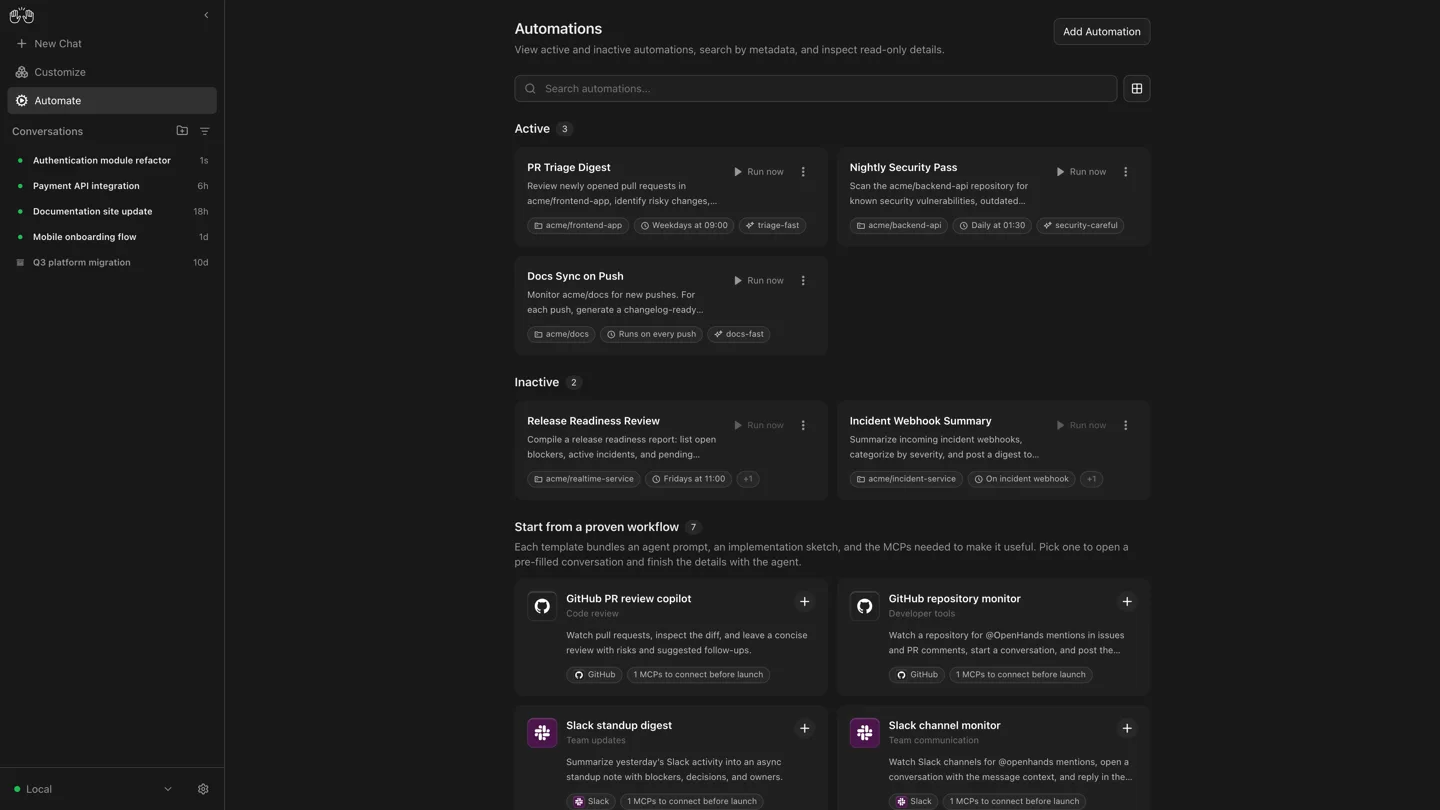
The current OpenHands repository presents Agent Canvas as a control center for agents, conversations and automations. It can use the OpenHands agent and documented compatible agent connections, while separating the interface from the execution backend. This page describes that current product rather than assuming older OpenHands screenshots and installation guides still match it.
The useful idea is to make ongoing agent work easier to organize: choose where code executes, maintain conversations and define repeatable triggers. The application remains beta software. Agent output, backend isolation and integration permissions should be checked for the chosen setup before the workspace becomes part of a routine engineering process.
Investigate a repository issue
Prepare a documentation update
Evaluate a repeatable engineering task
Compare execution arrangements
Official product image. Click to inspect the details.

Read the current setup guide
Choose the backend and workspace
Configure the agent and task
Review before repeating
Example prompt or task: In this dedicated repository checkout, identify the cause of the reported issue and propose the smallest relevant patch. Explain the affected files and verification steps; stop for review before any deployment or external publication.
This is an editorial example, not a measured OpenHands run. The actual agent’s tools, approvals and execution permissions depend on the configured backend.
Self-hosting the application is the free qualification. It does not include unlimited model calls, cloud compute or third-party agent subscriptions.
The Agent Canvas repository is MIT-licensed and supports a free self-hosted software route. You still supply the machine or host, maintain the application and configure a supported inference arrangement.
OpenHands commercial offerings, cloud execution resources, LLM APIs and external agents can have separate billing or subscription requirements. An open-source interface does not transfer paid entitlements from one provider to another, and this page does not promise free hosted compute or unlimited agent usage.
The self-hosted software is MIT-licensed. Inference, infrastructure and commercial services are separate.
The current repository identifies the application as Agent Canvas. Check current instructions instead of assuming older tutorials still match.
The project documents OpenHands and compatible ACP agent paths. Each agent has its own requirements.
No. Native execution can have broad filesystem access. Review the backend configuration explicitly.
No. Sessions can still share a mounted host directory. Use separate workspaces when tasks might interfere.
The project describes scheduled and webhook automation. Configure scope, permissions and failure behavior before enabling it.
Use the self-hosting guidance and appropriate access controls; a development setup is not automatically a public service.
Explore platforms, inputs and outputs, licensing, and access requirements.
Current instructions include container and local setup paths, with a separate Windows guide. Follow the versions and prerequisites specified by the current repository because a beta application can change its packaging and supported routes.
The input is typically a repository or working directory plus task instructions and any connected context. Outputs can include code changes, documentation and automation results. Preserve the accepted artifacts in the project’s normal version-control or storage process rather than relying only on a conversation history.
A native unsandboxed agent server can access the host filesystem according to its runtime permissions. A container changes the boundary but mounted directories and connected credentials still matter. Review the actual configuration rather than treating the word “agent” or “container” as a complete security model.
Task context can travel to model providers and connected integrations. Use only approved data, control secrets and tokens, and avoid sharing a writable project directory between unrelated tasks that might modify the same files.
Reviewed October 3, 2026. Product facts come from the official sources below. Suggested projects, prompts and review methods are FindGoodAI editorial guidance, not measured performance results.
Loading experiences…
Saved tools are private. Approved comments are public; edits return to moderation. Comment counts include approved comments and replies. Each person has one rating. New ratings are automatically approved; withdrawn, unapproved or invalid ratings do not count. Share real experiences and avoid spam, private information or personal attacks.
For moderation appeals or data requests: support@findgoodai.com
Bring a real task and see how it fits the way you work.
User experiences