JetBrains Junie
CodingJunie combines a coding agent with planning, model choice and JetBrains development workflows. Use the CLI, supported IDE integration or repository automation to work on scoped code changes.
A free open-source visual builder for agents and retrieval workflows, with Python components, a testing playground and API or MCP integration paths.
Langflow is a Python-based visual environment for building AI applications from connected components. Its official materials describe agents, retrieval-augmented generation, model and vector-store integrations, a playground and ways to expose a flow to other applications. The canvas helps make the path from input to output visible while retaining a code customization route.
It is useful when a team needs to understand how a workflow operates instead of hiding all behavior in one long prompt. A diagram is still an executable system: component settings, model behavior, data quality and deployment choices determine what actually happens. Start with one measurable task and examine the intermediate outputs.
Ask questions about a small document set
Prototype a support assistant
Compare processing designs
Expose a repeated workflow to an app
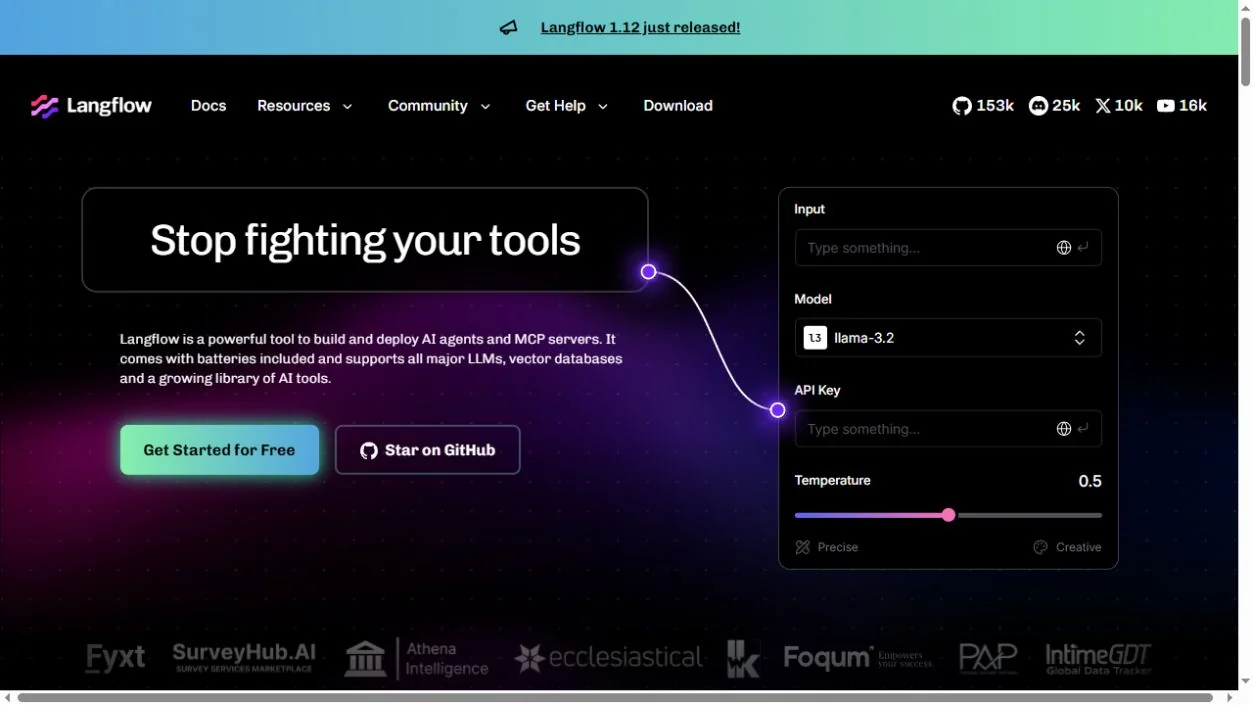
Official product image. Click to inspect the details.

Choose an installation route
Assemble the smallest useful flow
Inspect intermediate results
Package and connect carefully
Example prompt or task: Create a document question-answering flow for a small employee handbook. Return an answer with the supporting passage metadata when available; clearly report when the documents do not contain the requested information.
This is an editorial starter task. Citation behavior must be deliberately implemented and checked; a RAG diagram alone does not guarantee grounded answers.
The verified free route is the self-hosted software. Provider APIs, embeddings, storage and optional hosting have their own terms.
Langflow is distributed under the MIT license and provides a free self-hosted software route. Running the editor locally does not itself require a paid Langflow subscription, but your device, storage and maintenance still have costs.
The model, embedding service, vector database and deployment host may each charge separately. A locally configured model or database can change that cost structure, subject to its own license and hardware needs. This page does not promise an unlimited free cloud plan based on a promotional sign-up button.
The MIT-licensed software can be self-hosted for free. Models and connected infrastructure are separate.
Basic flows can be assembled visually, while custom components and deployment work benefit from Python and API knowledge.
Yes, retrieval workflows are a documented use case. You still need to evaluate ingestion, retrieval and answer grounding.
The open-source license does not grant unlimited inference from external providers.
Official API examples support application integration. Configure access controls and a stable input/output contract.
Agent and MCP capabilities provide tool integration paths. Review the permissions and supported behavior for your configuration.
No. Dependencies, component versions, data and model settings also matter.
Explore platforms, inputs and outputs, licensing, and access requirements.
Official installation materials cover desktop and developer-oriented deployment routes. Select the option that fits the operating system and maintenance skills available, and follow the current version requirements rather than assuming an old installation command remains appropriate.
Typical inputs include messages, documents and parameters passed by an application; outputs depend on the components and response contract you build. Exported flow definitions help preserve structure, but reproducing a result also requires compatible component versions, data, credentials and model configuration.
A local canvas can send document content to remote embedding, model or storage services. Map the complete data path and choose providers suitable for the material before importing private documents.
Keep secrets out of shared flow exports and custom component source. Treat an exposed flow endpoint as an application service with authentication, appropriate tool permissions and an owner responsible for updates.
Reviewed October 3, 2026. Product facts come from the official sources below. Suggested projects, prompts and review methods are FindGoodAI editorial guidance, not measured performance results.
Loading experiences…
Saved tools are private. Approved comments are public; edits return to moderation. Comment counts include approved comments and replies. Each person has one rating. New ratings are automatically approved; withdrawn, unapproved or invalid ratings do not count. Share real experiences and avoid spam, private information or personal attacks.
For moderation appeals or data requests: support@findgoodai.com
Bring a real task and see how it fits the way you work.
User experiences