
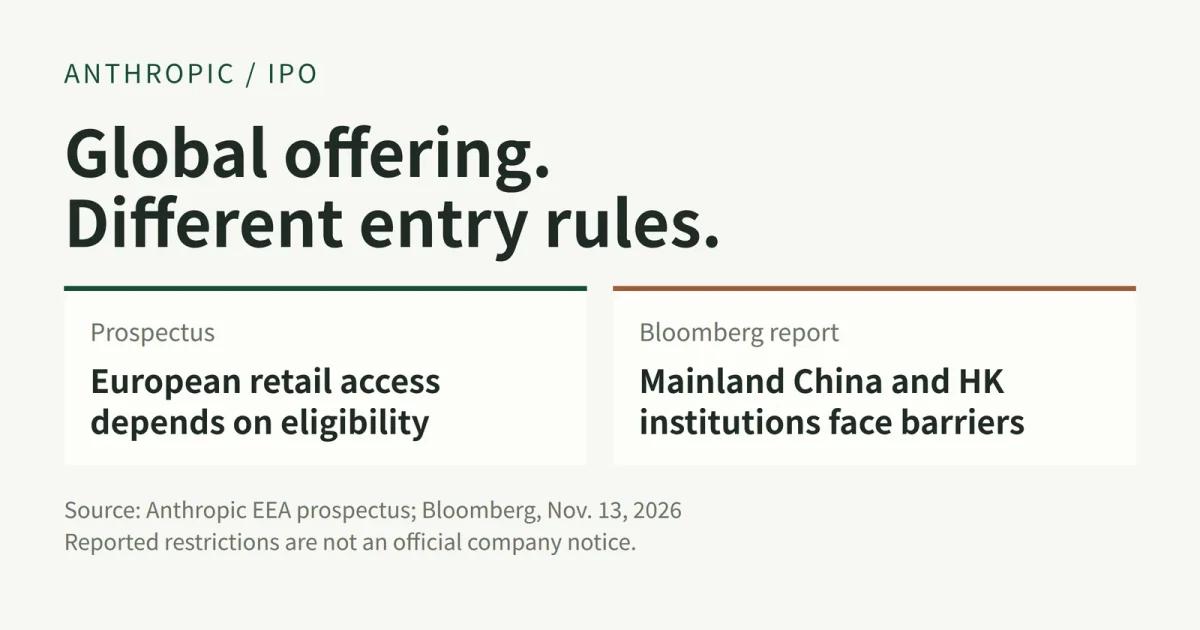
For capital seeking exposure to frontier AI, Anthropic's move toward public markets does not make IPO access universal. Bloomberg reported on November 13, 2026 that mainland China and Hong Kong institutions faced restrictions on subscriptions, even as the company's European prospectus sets out an international offering. Broadening distribution and filtering participation can happen at the same time.
More retail routes do not imply open institutional access
The European prospectus filed with the SEC describes public offerings in the United States, Europe, Switzerland, Australia, Japan, the United Kingdom and parts of Canada, alongside private placements. Its European retail component has its own investor-classification and location requirements. It is not an invitation to buyers everywhere.
Bloomberg's reporting concerns a different layer: banks declining institutional orders or judging an allocation unlikely. Bloomberg attributes the constraints partly to the U.S. International Traffic in Arms Regulations, or ITAR, but the publicly readable portion does not explain the specific mechanism. The report relies on unnamed interviewees and does not establish a blanket prohibition covering all investors.
Read together, the documents suggest segmented access rather than a simply open or closed offering. Geography, investor category and placement channel each matter. Cross-border investors must assess which part of an offering they can enter, rather than treating their view of an AI company's growth prospects as the only relevant consideration.
Economic ownership need not bring influence over direction
The same prospectus identifies another boundary. Through Class T shares, the Long-Term Benefit Trust, or LTBT, generally has authority to elect and remove directors holding a majority of the board's authorized seats. Immediately before completion of the global offering, Anthropic also plans to issue a single Class F share to Founder LLC, an entity organized by its co-founders. That share will carry 50.1% of the voting power on matters submitted to stockholders generally. The issuance remains a planned step.
Under this structure, the company expects the LTBT and Founder LLC collectively to be able to elect all directors. Class A shareholders generally will not be able to affect shareholder voting or director election outcomes. A broader fundraising base therefore does not automatically disperse corporate control.
That governance arrangement does not explain the reported barriers facing mainland China and Hong Kong institutions. It illustrates a separate distinction: eligibility to acquire shares and influence over the company are different rights. Reading an IPO as both unrestricted access for capital and shared authority over research priorities would misread the offering and the shareholder structure.
The next useful evidence would be published terms from the issuer or underwriters defining affected jurisdictions, investor categories and any exceptions. Without those terms, the reporting does not establish a uniform rule, its duration, or whether it would extend to purchases after trading begins.