
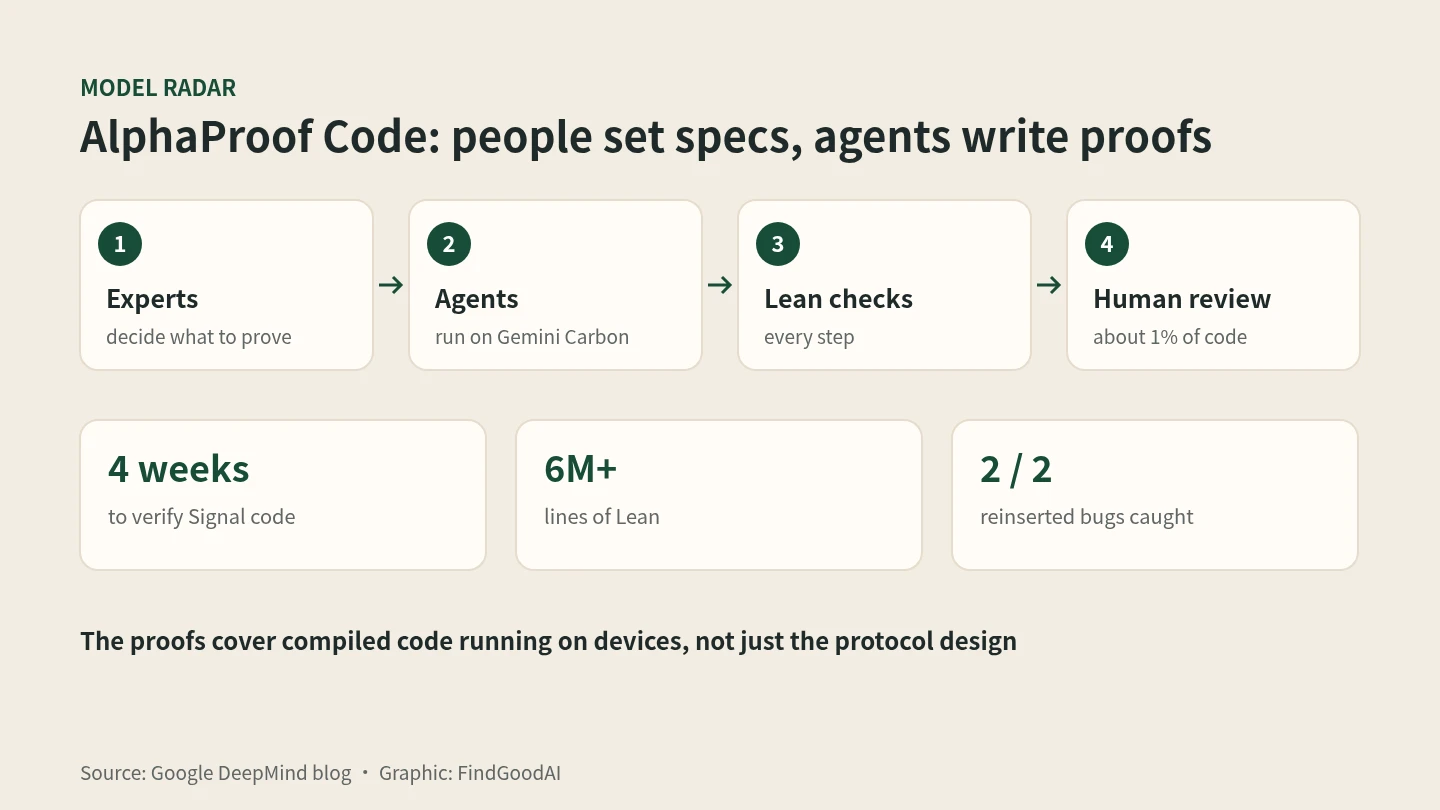
Google DeepMind introduced AlphaProof Code on November 10, an agent framework for formal verification. Human experts decide what to prove, several LLM agents write the proofs, and the Lean proof assistant checks every step. Its first result is a verification of the Signal protocol code, which protects private messages in Signal and Google Messages.
What it did
- Down to compiled code: the proofs cover the code that actually runs on devices, including keeping messages safe before and after a temporary device compromise. Most earlier work stopped at the protocol design.
- Four weeks: DeepMind says comparable work used to take expert teams years.
- Scale: the agents produced more than six million lines of Lean and flagged about 1% of the codebase for human review; experts reviewed every specification.
- Model: the agents ran on Gemini Carbon.
- Bug detection: two previously fixed bugs were put back into an isolated copy, and in both cases the system produced a machine-checked proof that the version was insecure.
Can you use it?
Not as a product. DeepMind says it is open-sourcing the verification artifacts at google-deepmind.github.io/code-verification and has published a technical paper, but it mentions no API or commercial offer. Next, it suggests applying the approach to systems such as medical-device firmware and power-grid software, and pairing it with CodeMender, its automated patching agent.
Who it affects
Security and infrastructure teams have mostly skipped formal verification on large codebases because of the labour involved; if the cost really drops to weeks, critical modules become candidates. Everyday users have nothing to try yet. For the model behind it, see the Gemini 4 Carbon launch, and Google’s models are available in Gemini and Google AI Studio.