
Together AI
CodingTogether AI is a cloud for open models: serverless APIs for models such as Kimi, DeepSeek and Qwen, dedicated endpoints, fine-tuning and GPU clusters.
Serverless inferenceDedicated capacity
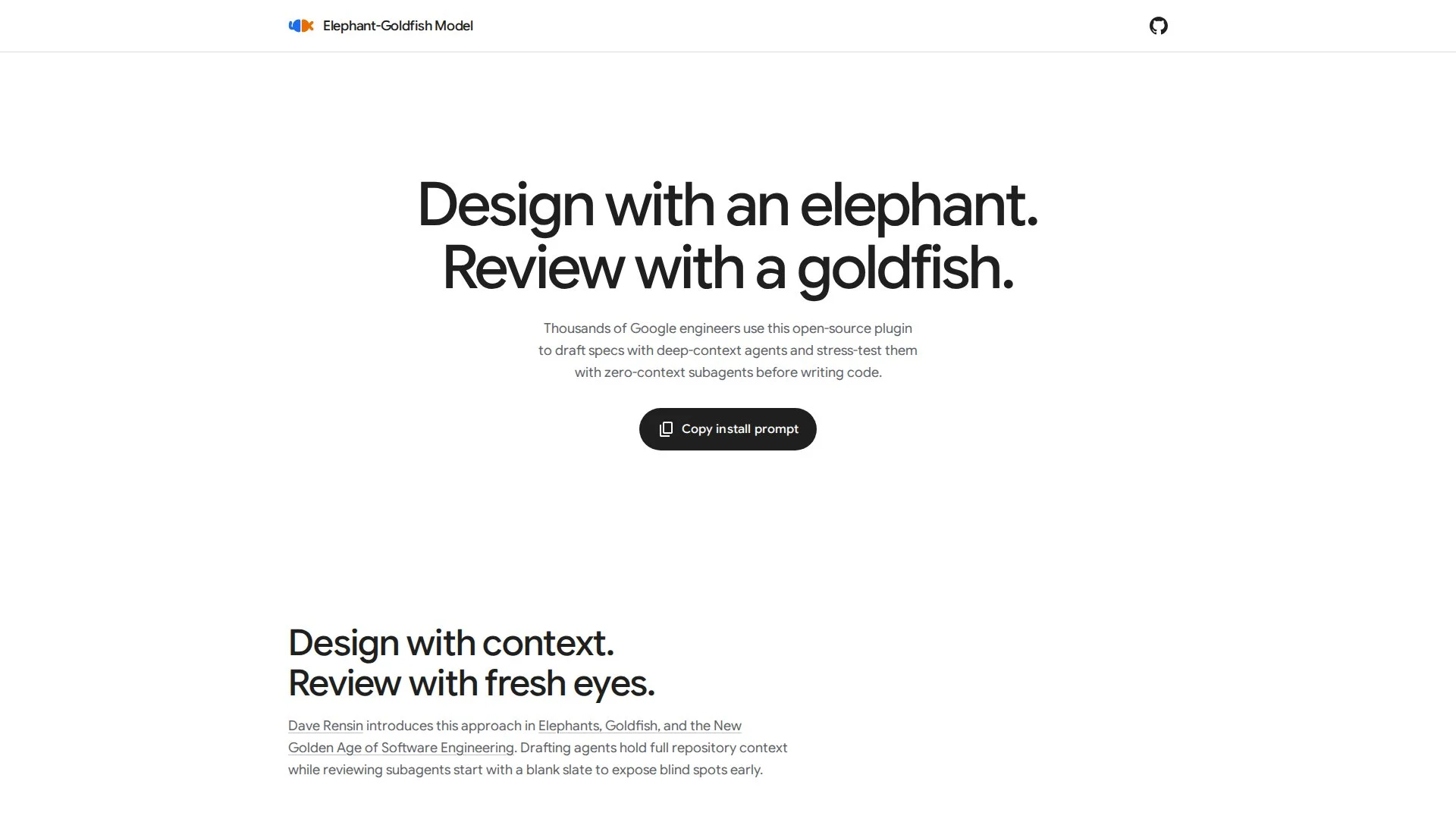
EGM is Google’s open-source plugin for Claude Code, Codex and Antigravity: one agent drafts a spec with full context, fresh subagents review it before code.
Elephant-Goldfish Model (EGM) is an open-source plugin for AI coding assistants, published by Google on GitHub under Apache 2.0. It splits design into two roles. The “elephant” holds your project context — history, architecture, requirements and earlier decisions — and drafts the specification. The “goldfish” reviewers are fresh subagents that read only the draft and the source code it references, without the conversation, so they notice assumptions the drafting agent took for granted. You resolve the trade-offs and approve the spec before your agent writes code. The site says thousands of Google engineers use it; the README notes it is not an officially supported Google product.
Editorial suggestion: use it on a feature where mistakes are expensive, such as payments, permissions or data migration, rather than on a one-line fix. The extra review rounds take time and model quota, and they pay off when a wrong assumption would be costly to undo.
Risky features
Design reviews
Legacy projects
After release
Official product image. Click to inspect the details.
Official examples and public-page captures; these are not results from a paid-feature trial.
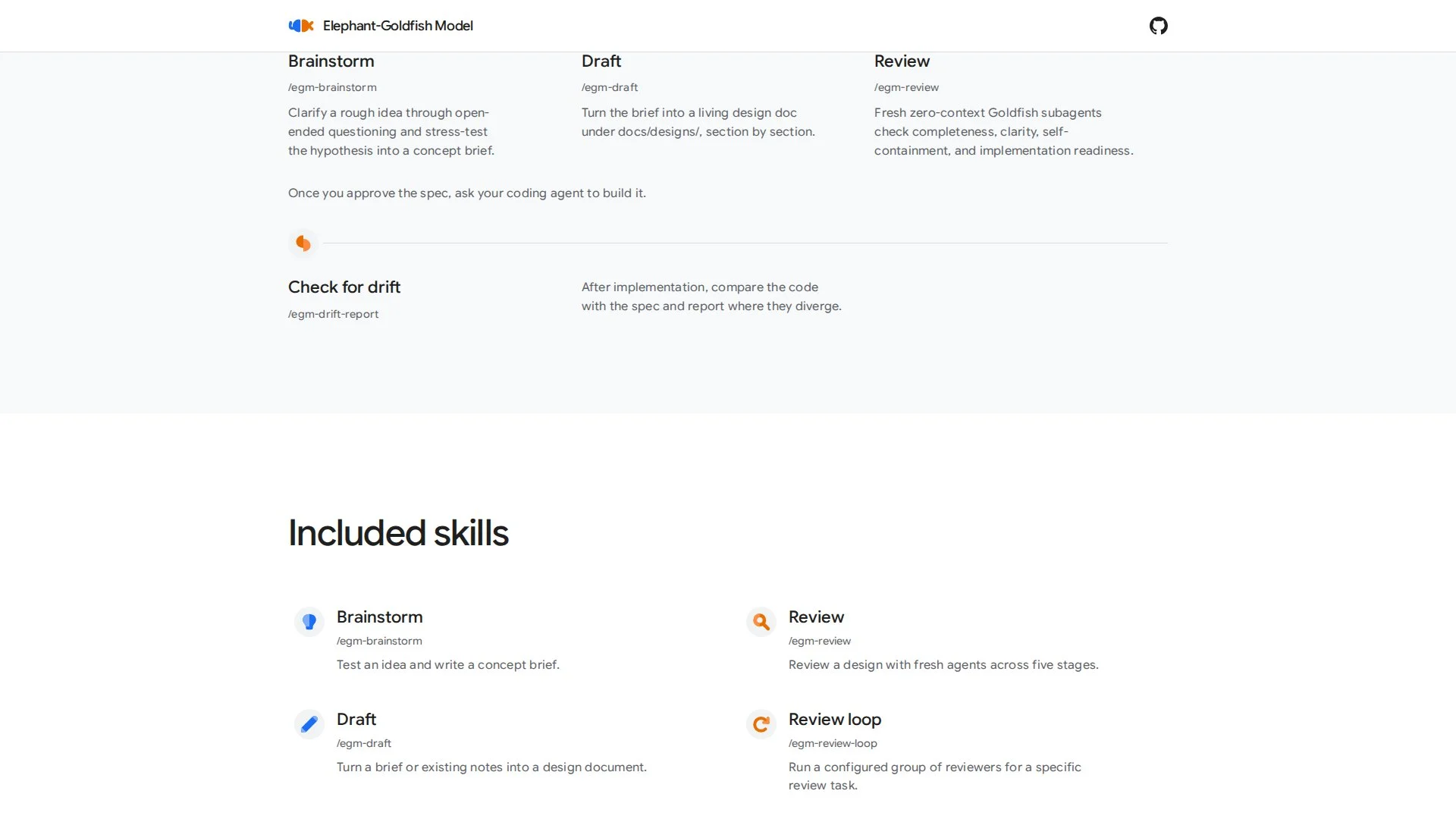
/egm-brainstorm tests an idea through questions and saves a concept brief; /egm-draft turns it into a design document under docs/designs/, pausing after each section for your feedback.
/egm-review sends the draft to fresh subagents across five stages that check completeness, clarity, self-containment, fit with the code and implementation readiness.
/egm-resolve works through findings with you, and /egm-review-loop runs a chosen group of reviewers for other documents.
/egm-bootstrap writes or updates docs for an existing codebase, and /egm-drift-report compares checked-in docs with the code after implementation.
Install the plugin
Start a new session
Brainstorm and draft
Review, then build
Claude Code: claude plugin marketplace add google/elephant-goldfish-model, then claude plugin install egm@egm. Codex CLI: codex plugin marketplace add google/elephant-goldfish-model, then codex plugin add egm@egm. Antigravity: agy plugin install https://github.com/google/elephant-goldfish-model.
Open your project in a new session so the skills load; in Claude Code and Antigravity CLI use the /egm: prefix.
Run brainstorm with a one-line goal, agree on the brief, then draft the design section by section.
Run review on the draft, decide which findings to fix, approve the spec and only then ask the agent to implement.
EGM is free and open source under the Apache 2.0 licence. There is no paid plan; you install it from GitHub or, for ChatGPT and Codex desktop, from the published plugin listing.
It runs inside your coding assistant, so model usage counts against that assistant’s plan. Brainstorming and review start fresh subagents, which uses extra calls and quota compared with a single chat.
Yes. It is open source under Apache 2.0; model usage is billed through your coding assistant.
Claude Code, Codex CLI and desktop, Antigravity CLI, app and IDE extension, with setup guides for Claude Cowork and ChatGPT Work.
Reviewers without the drafting conversation are more likely to spot assumptions the author never wrote down.
It is published by Google on GitHub, but the README states it is not an officially supported Google product.
Yes, with /egm-review-loop and reviewers you choose; the built-in workflow targets software specs.
No. It produces an approved spec; you then ask your coding agent to implement it.
Explore platforms, inputs and outputs, licensing, and access requirements.
These tools overlap with parts of the workflow; compare the specific task, export requirements and current plan rather than treating them as identical products.
EGM sends your code and documents to whatever model your coding assistant uses, so the same data rules apply as for that assistant. Reviews need an agent that can create fresh subagents; if it cannot, EGM stops the review. Reviews do not replace tests or human judgement.
Loading experiences…
Bring a real task and see how it fits the way you work.
User experiences