Weaviate
CodingWeaviate is an open-source AI vector database featuring hybrid search, built-in vectorization, multi-tenancy and Query Agent, with an always-free $0/month cloud tier (10 GB disk).
Tinker is Thinking Machines Lab’s training API: you write the loop, it runs LoRA fine-tuning and RL on Inkling, Kimi, GPT-OSS and Qwen models on shared GPUs.
Tinker is training infrastructure from Thinking Machines Lab for people who want to customise large open models without running GPU clusters. Your own code controls the training loop through a small API, while Tinker schedules the work across shared GPU pools and recovers from infrastructure failures. It is aimed at researchers and engineers who know what they want to train and would rather spend their time on data and reward design than on cluster operations.
Editorial suggestion: treat Tinker as a research tool, not a one-click fine-tuning service. Start with a small model and a few hundred examples, measure against a held-out set, and only then scale up to larger models or reinforcement learning.
Domain fine-tuning
RL for agents
Distillation
Research
Official product image. Click to inspect the details.


Official examples and public-page captures; these are not results from a paid-feature trial.
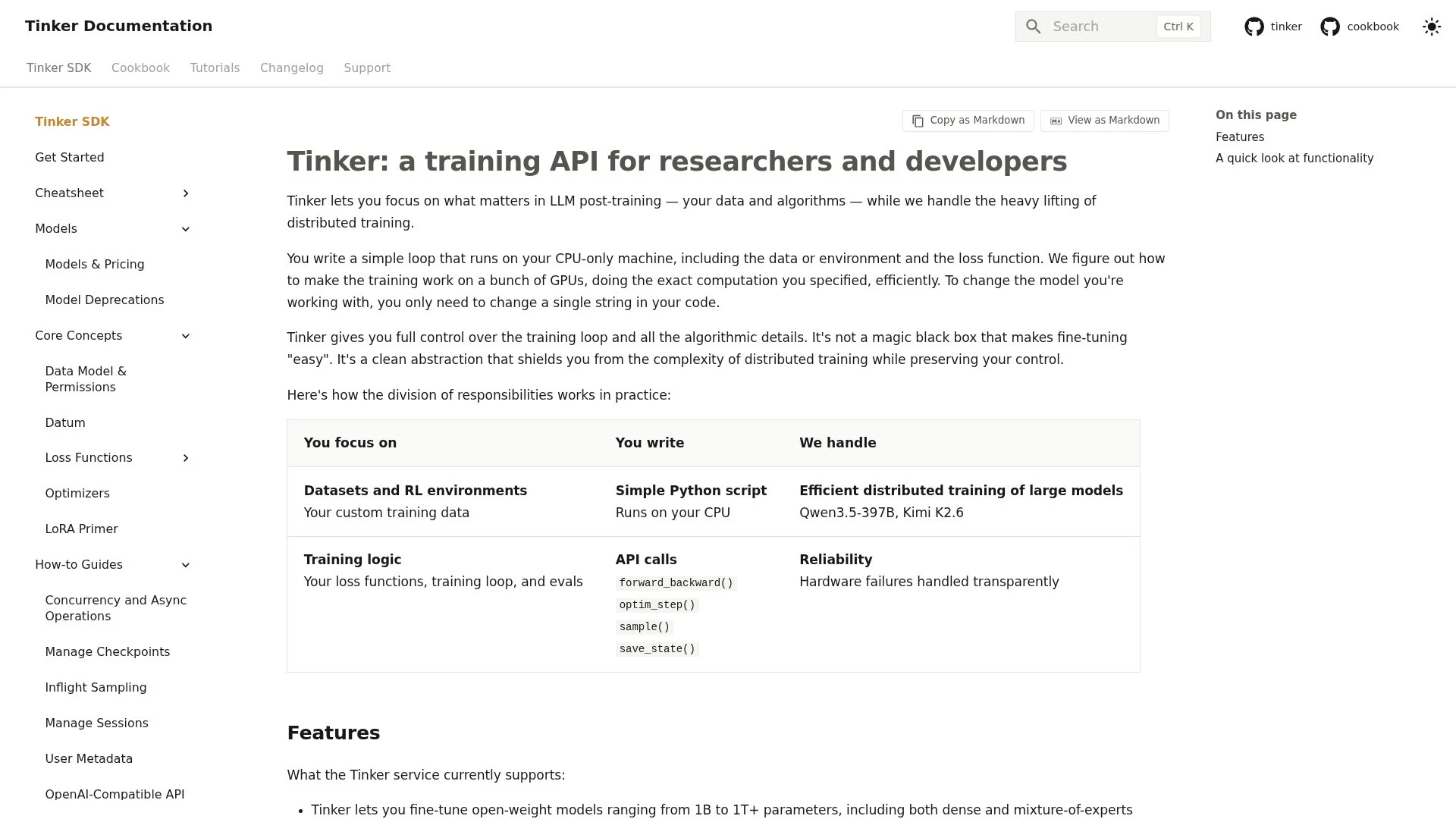
sample generates tokens for chat, evaluation or RL rollouts; forward_backward accumulates gradients; optim_step updates weights; save_state checkpoints so training can resume.
Tinker trains a small adapter instead of all base weights. Thinking Machines says that with the right setup LoRA matches full fine-tuning while needing less compute.
Inkling 2 Small (594B total, 17B active), Inkling (975B, 41B active) and Inkling-Small (276B, 12B active), all with 256K context, plus Kimi-K2.6, GPT-OSS and Qwen models.
Recipes cover supervised fine-tuning, RL including math and terminal agents, RLHF and on-policy distillation; serverless inference for the Inkling models is in beta.
Sign up
Pick a small model
Run a recipe
Evaluate, then scale
Create an account on the Tinker site; universities and organisations needing wide access can contact the team.
Start with a small Qwen or GPT-OSS model to keep the first runs cheap.
Use the supervised fine-tuning recipe on a few hundred examples and save checkpoints.
Compare against a held-out set with sample before moving to larger models or RL.
Training, sampling and prefill are priced per million tokens, and the rate depends on the model and context length. The Tinker page links to a separate pricing table for the exact rates; check it before a large run.
Checkpoint storage costs $0.10 per GB per month. Serverless inference for the Inkling models is billed per million tokens.
No. You write the training loop in code; Tinker runs it on its GPUs.
It uses LoRA adapters. Thinking Machines says LoRA can match full fine-tuning with the right setup.
The Inkling family, plus models such as Kimi-K2.6, GPT-OSS-120B, GPT-OSS-20B and Qwen; the full list is on the site.
Per million tokens for training, sampling and prefill, varying by model, plus $0.10 per GB per month for storage.
Serverless inference is in beta for the Inkling models; check the docs for other models.
ML engineers and researchers who want control over data, rewards and the training loop.
Explore platforms, inputs and outputs, licensing, and access requirements.
These tools overlap with parts of the workflow; compare the specific task, export requirements and current plan rather than treating them as identical products.
You upload training data to Thinking Machines’ shared infrastructure, so remove personal or confidential records you do not need and check the data terms in your agreement. Some older base models are being retired, so confirm a model is still supported before you build on it.
Loading experiences…
Bring a real task and see how it fits the way you work.
User experiences