
Ricursive Intelligence, a US lab that also builds a chip-design platform, released Ripple-65B Preview on November 6. It is a general-purpose preview of the model behind its own platform, aimed at agentic coding. The weights are on Hugging Face under Apache 2.0.
Key specs
- Architecture: a dense 65-billion-parameter Transformer, not a mixture of experts, with 80 layers in a thin-and-deep design.
- Context: up to 1,048,576 tokens.
- Training: pretrained from scratch on 12 trillion tokens of mostly English text and code; text only. Post-training is light and focused on agentic coding.
- Running it: the authors say it fits on consumer hardware such as NVIDIA DGX Spark and provide an NVFP4 checkpoint and a Colab notebook. They report about 250 tokens per second on two B200 GPUs before quantisation.
- Cost: the company says full R&D, including pretraining, data, evaluation and post-training, cost $32 million, which it estimates at about a tenth of the previous best open-weight coding model.
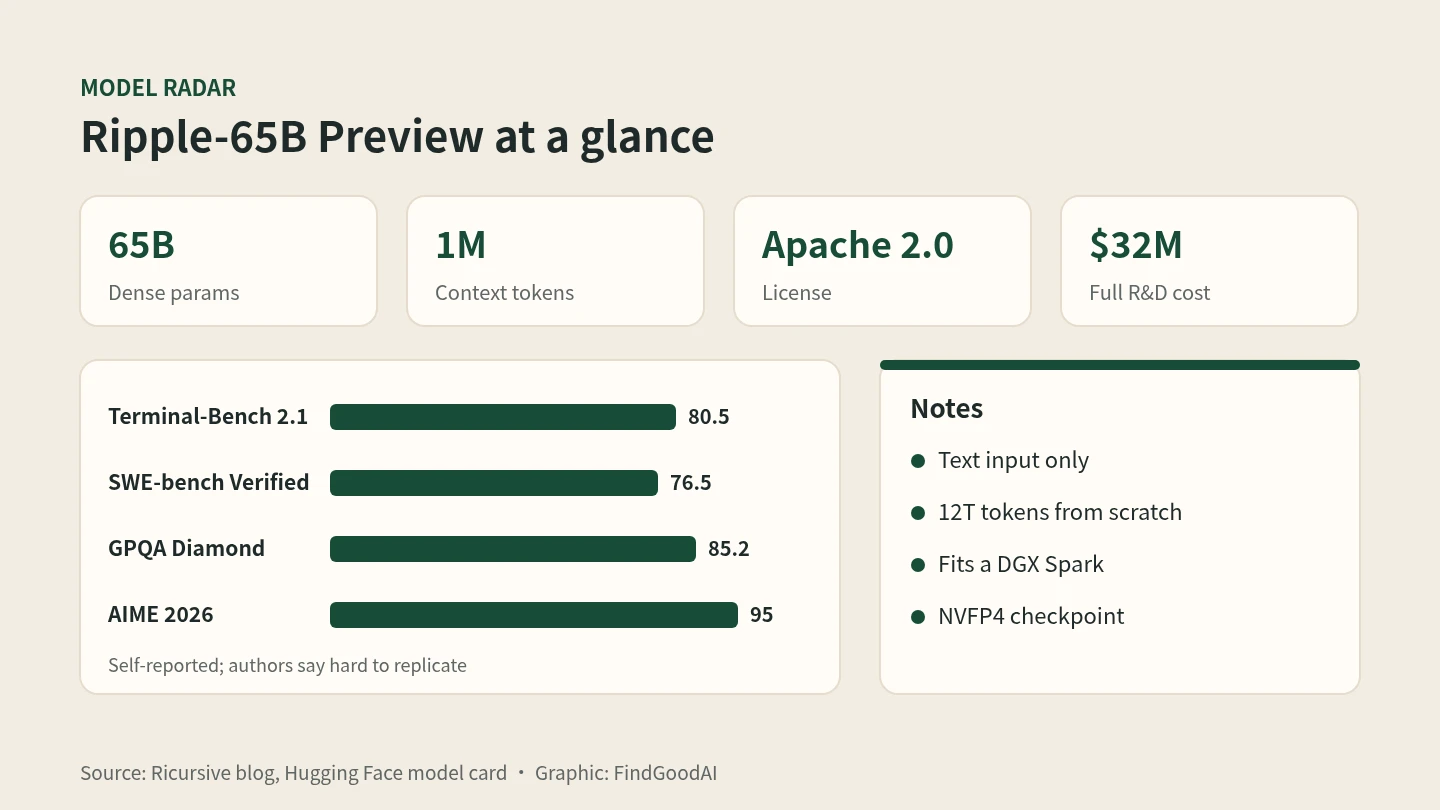
Self-reported results
80.5 on Terminal-Bench 2.1, 76.5 on SWE-bench Verified, 85.2 on GPQA Diamond and 95.0 on AIME 2026. The model card is candid that these are hard to replicate: Terminal-Bench scores were generally lower with the official Terminus 2 harness at 128K context.
Who it affects
For developers who want to run a coding model locally or on company servers, the draw is the Apache 2.0 license at 65B. Compare it with larger open models such as Kimi K3.1 Pro; for local tests in Ollama you will need community quantisations. The blog lists Together AI, OpenRouter and Fireworks as hosts, while the Hugging Face page showed no inference provider at the time, so check before you plan on an API. It does not accept images.
Sources: Ricursive Intelligence: Ripple; Hugging Face: Ripple-65B-Preview