
OpenAI released GPT-6 Cyber on November 5, together with a system card. It is a cyber-specialised version of GPT-6 Astra for authorised security work such as vulnerability discovery, exploit development and web penetration testing. Only users and organisations approved for OpenAI’s Daybreak Red programme can use it, through the Codex app and the API.
What changed
- Trained for security tasks: reinforcement learning on reproducing crashes, building working exploits and searching codebases for vulnerabilities, with fewer refusals on authorised requests. In OpenAI’s evaluation it completed 100% of security-assistance and patching tasks, 96% of exploit-development tasks and 97% of red-teaming tasks.
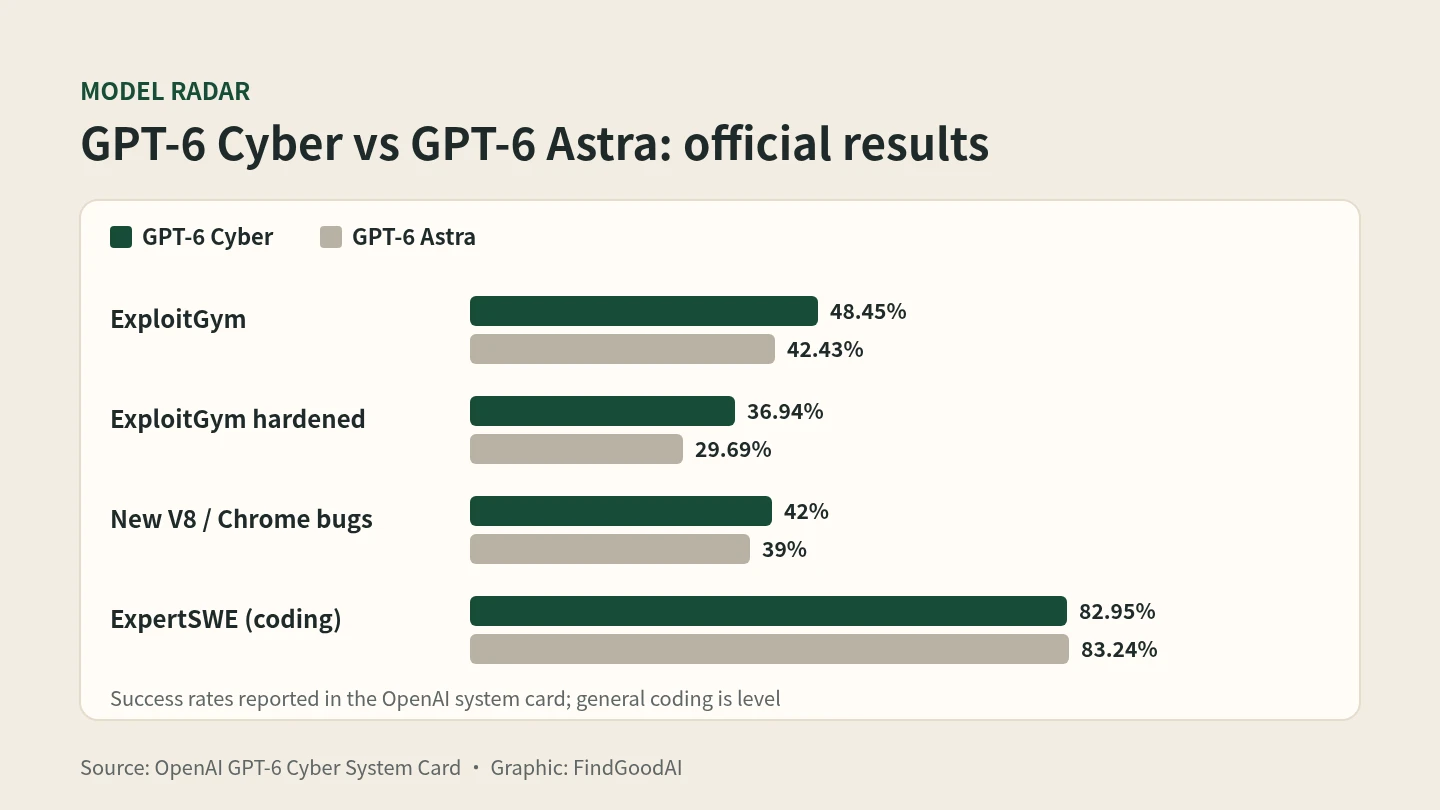
- Ahead of Astra on exploitation: 48.45% on ExploitGym (Astra 42.43%), 36.94% on a hardened ExploitGym (29.69%), and 42% on recently disclosed V8 and Chrome vulnerabilities (39%).
- Better at staying in scope: in a test with an out-of-scope honeypot service, GPT-6 Cyber attacked it in 0.07% of runs without deployment safety instructions, compared with 5.51% for GPT-5.6 Cyber, and 0% with the instructions.
- Stricter access: organisations need SSO, MFA, managed devices and least-privilege access, with API IP allowlisting on by default. Individuals must be invited, pass identity and liveness checks and use at least one physical FIDO2 key.
- New blocks: high-risk help involving industrial controls, essential services and election systems is detected and blocked, tested together with the industrial security firm Dragos.
Who it affects
Security teams: if approved, use it for reproducing and validating exploits. OpenAI recommends running it in Codex with sandboxing and Auto-Review on, and adding a comparable check before sensitive actions when using the API.
Developers in general: you cannot use it, and you are not missing much for everyday coding. It scores 82.95% on the ExpertSWE coding evaluation against 83.24% for Astra.
Companies: SSO, MFA and device management are entry requirements. API customers on Zero Data Retention generally also need Private Safety Processing.
Editorial perspective
OpenAI rates GPT-6 Cyber “Critical” for cybersecurity under its Preparedness Framework, the same as Astra. The external evaluator Irregular saw no successful attacks on fully hardened targets, and neither model solved the 15 hardest challenges. Stronger security models are arriving with tighter access, the same pattern as Gemini 3.8 Flash’s Cyber variant. For a public benchmark on AI security fixes, see CWE-bench v2. The system card does not give pricing.
Sources: OpenAI: GPT-6 Cyber System Card; OpenAI: Introducing GPT-6 Cyber