JetBrains Junie
CodingJunie combines a coding agent with planning, model choice and JetBrains development workflows. Use the CLI, supported IDE integration or repository automation to work on scoped code changes.
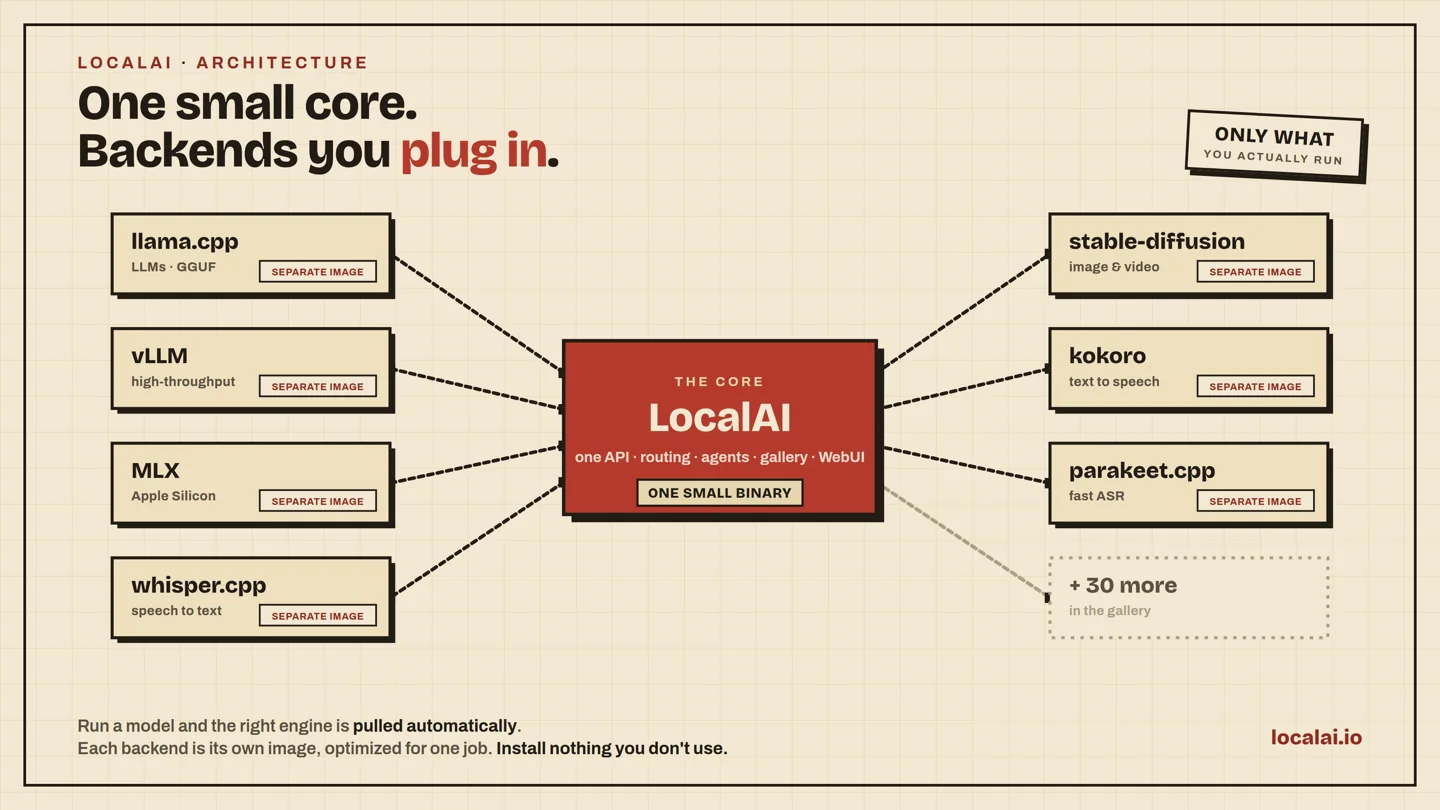
An open-source inference runtime that serves local models through familiar API interfaces. It supports multiple model backends and modalities, making it useful for developers building self-managed AI services rather than relying on a single hosted provider.
LocalAI provides a service layer for running models on hardware you manage. Its API compatibility makes it useful when an existing application expects a familiar model endpoint, while the operator wants more control over the selected model, deployment location and resource allocation. It can also provide a web interface for exploring installed models.
This is infrastructure software rather than a promise that every AI capability is available at the same speed on any computer. A text model, an image model and a speech model can require different backends and resources. Begin with the smallest useful service, understand its behavior and then expand deliberately.
Prototype a self-managed assistant
Test API portability
Build a local document pipeline
Explore audio processing
Official product image. Click to inspect the details.

Choose a narrow service
Install the matching runtime
Verify a direct request
Protect and observe
Example prompt or task: Create a small local API experiment that sends three public test prompts to the selected model, validates the expected response structure and records failures without retrying indefinitely.
This is an editorial starting workflow, not a measured performance result.
LocalAI's runtime is distributed under MIT and does not require a mandatory software subscription. Local execution uses the operator's hardware, storage and power, while individual model weights and dependencies can have their own licenses and restrictions.
Hosted infrastructure, remote model calls and external tools can introduce charges. A free runtime is therefore a deployment choice rather than a guarantee of zero operating cost. Estimate the actual workload on a representative machine before deciding whether self-hosting is economical.
The runtime is MIT-licensed software; operating resources remain your responsibility.
No. CPU routes exist, but practical performance depends on the model and workload.
No. Verify the exact features and response contract your application needs.
No. Different tasks can require different models and backends.
Yes, that is a central use of its model-serving API.
No. The runtime license is separate from model licenses.
No. Use access controls appropriate to the deployment and audience.
Explore platforms, inputs and outputs, licensing, and access requirements.
The documentation provides installation, container and hardware-specific guidance. Choose the supported runtime for the actual CPU or GPU rather than copying a generic command and assuming acceleration is active. A working endpoint can still be running on a slower path than expected.
The quickstart distinguishes simple API-key protection from user authentication with separate roles. A simple key grants broad access and is not a substitute for a multi-user permission design. Do not expose a local experiment publicly until the intended clients and access controls are clear.
Self-managed inference can keep model processing within a chosen environment, but downloaded components, connected tools and remote providers can introduce other data paths. Document those paths before making a claim that an entire application is local-only.
Protect endpoint credentials and restrict administrative access. For shared services, separate users and roles, retain useful operational logs without unnecessary prompt content, and keep a recoverable configuration before upgrading the runtime or replacing models.
Reviewed October 3, 2026. Product facts come from the official sources below. Suggested projects, prompts and review methods are FindGoodAI editorial guidance, not measured performance results.
Loading experiences…
Saved tools are private. Approved comments are public; edits return to moderation. Comment counts include approved comments and replies. Each person has one rating. New ratings are automatically approved; withdrawn, unapproved or invalid ratings do not count. Share real experiences and avoid spam, private information or personal attacks.
For moderation appeals or data requests: support@findgoodai.com
Bring a real task and see how it fits the way you work.
User experiences