Murf
Audio & musicCreate voiceovers from scripts and refine delivery with voice, pronunciation and pacing controls. Murf Studio serves content production, while Murf’s API, dubbing and conversational-agent offerings address different workflows.
A free self-hosted text-to-speech toolkit with a browser interface, reference-voice synthesis, optional fine-tuning and utilities for preparing speech datasets.
GPT-SoVITS combines text-to-speech inference and optional voice-model fine-tuning in a browser-based workflow. Its repository documents cross-language synthesis and utilities for preparing recordings, including segmentation, transcription and label review. It is a technical toolkit rather than a hosted subscription that supplies every resource automatically.
The practical starting point is a short, clean recording you are allowed to use. Try reference-guided inference before deciding whether a dedicated fine-tuning project is worthwhile. A voice can sound similar while still misreading a name, skipping a word or producing an awkward transition, so evaluate both the script and the sound.
Draft your own narration
Prepare multilingual samples
Improve a training dataset
Study a model upgrade
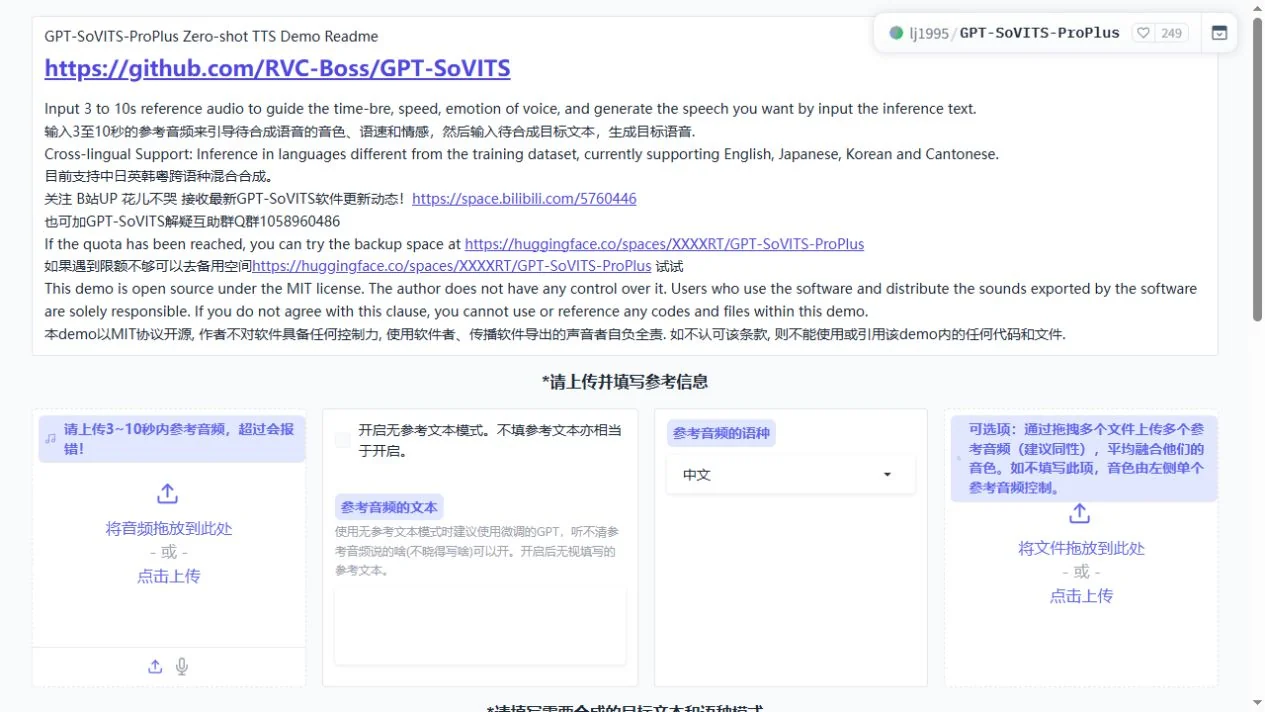
Official product image. Click to inspect the details.

Select the current installation route
Prepare permitted reference material
Generate a short sample
Review and preserve the result
Example prompt or task: Using my authorized reference recording, synthesize a short introduction to this tutorial. Keep the wording exactly as supplied, then review the names, numbers, pauses and sentence endings against the script.
This is an editorial evaluation task. FindGoodAI has inspected the official interface and documentation, not measured synthesis quality or trained a voice model.
The open-source route is not a promise of unlimited hosted demo capacity. Model and component conditions still apply.
The MIT-licensed software provides a free self-hosted route, with downloadable model assets referenced by the project. Hardware, electricity, storage and any rented GPU are separate costs. Check the conditions of the specific models and auxiliary components you install.
The official online demo is useful for understanding the interface, but it has capacity and quota constraints. It should not be treated as an unlimited free production service. Fine-tuning also requires preparation and review time even when the software itself has no subscription fee.
The software is MIT-licensed and self-hostable. Hardware and additional services cost separately.
Reference-based inference is available. Try it before committing to a fine-tuning dataset.
The current repository lists Chinese, English, Japanese, Korean and Cantonese.
No. Its current interface mentions quota limits and an alternate space.
No. Incorrect labels can carry into the preparation workflow and should be corrected by listening.
No. Match the model generation, interface and configuration.
Use recordings and voices you have appropriate permission to process and publish.
Explore platforms, inputs and outputs, licensing, and access requirements.
The repository documents Windows, Linux and macOS-related setup options with different device considerations. Inference and training have different requirements; a configuration that can produce one short sample does not establish that it is suitable for a larger training workload.
Typical inputs are reference audio, its text where required, a target script and language settings. Outputs are generated audio, and training workflows additionally produce model artifacts. Keep a simple record linking scripts, model versions and output files so later corrections do not rely on memory.
A local installation can keep the inference workflow on your own machine when all required assets are present. A hosted demo receives uploaded recordings, so choose the environment according to the material you intend to process.
A software license does not supply permission to imitate a person or reuse someone else’s recording. Keep consent and content rights separate from technical configuration, and avoid presenting synthesized speech as an authentic statement by another person.
Reviewed October 3, 2026. Product facts come from the official sources below. Suggested projects, prompts and review methods are FindGoodAI editorial guidance, not measured performance results.
Loading experiences…
Saved tools are private. Approved comments are public; edits return to moderation. Comment counts include approved comments and replies. Each person has one rating. New ratings are automatically approved; withdrawn, unapproved or invalid ratings do not count. Share real experiences and avoid spam, private information or personal attacks.
For moderation appeals or data requests: support@findgoodai.com
Bring a real task and see how it fits the way you work.
User experiences