
Cloudflare open-sourced Kitesurf on November 13 under the Apache 2.0 license on GitHub. Built specifically for AI agents rather than human browsing, Kitesurf runs entirely inside Cloudflare Workers isolates—parsing HTML, computing CSS, executing page JavaScript, and capturing screenshots or PDFs without spinning up Chromium containers.
What changed
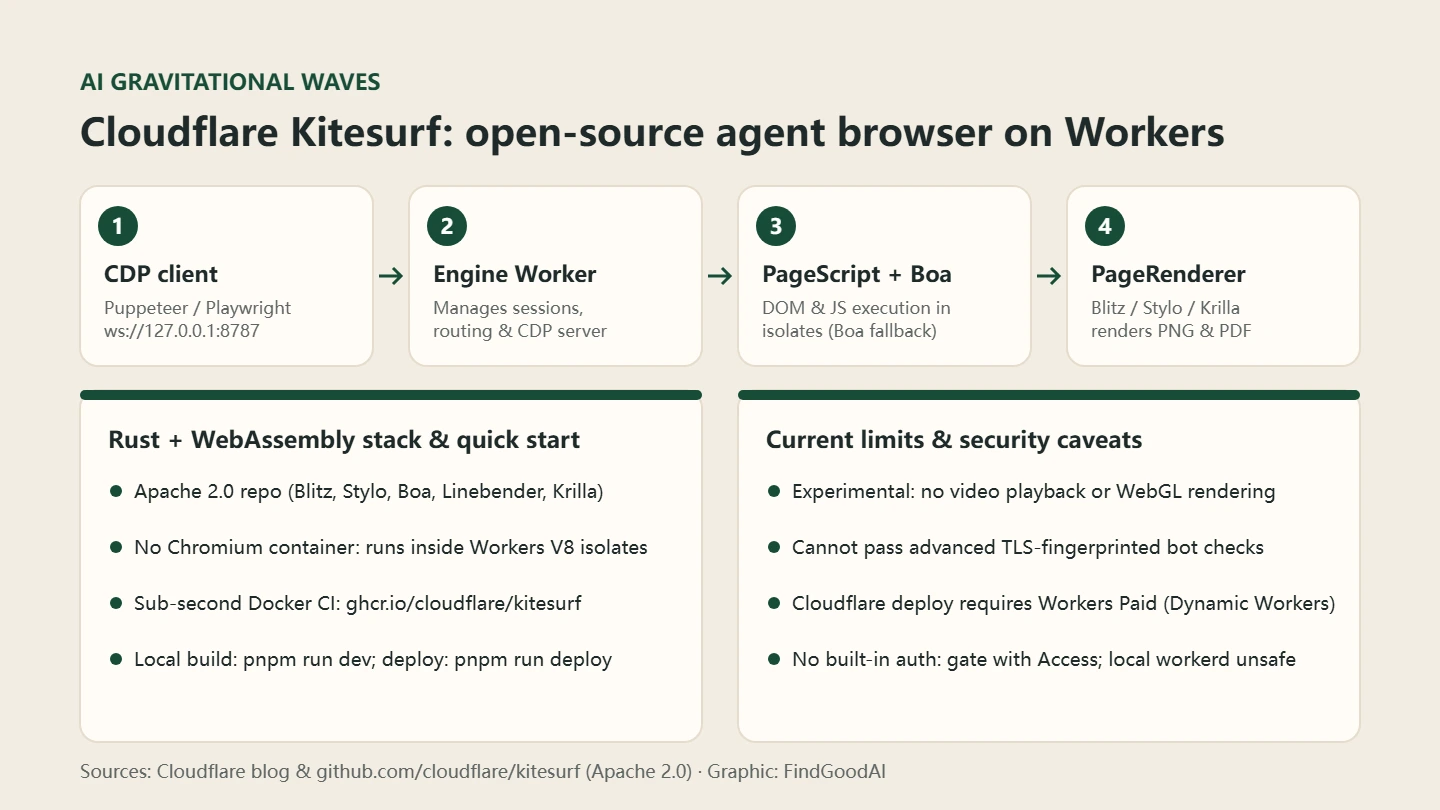
Running headless Chromium at scale forces agent builders to pay memory and cold-start overhead for tabs, extensions, and media pipelines agents never use. Kitesurf splits rendering into three stateless Workers components—Engine (sessions and CDP endpoint), PageScript (DOM and script execution), and PageRenderer (painting)—powered by Rust crates compiled to WebAssembly: Blitz for HTML/DOM/layout, Stylo for CSS, Boa as a Wasm JS fallback when Dynamic Workers cannot run scripts directly, plus Linebender and Krilla for text, 2D graphics, and PDFs. Native Chrome DevTools Protocol (CDP) support lets existing automation clients connect without rewrites.
How developers can use it
For CI end-to-end tests or quick local agent runs without a Cloudflare account, pull the prebuilt image—docker run --rm -p 127.0.0.1:8787:8787 ghcr.io/cloudflare/kitesurf—which starts in under a second on open-source workerd and warms up one page automatically, then point Playwright or Puppeteer at ws://127.0.0.1:8787/devtools/browser. You can also build locally with pnpm run dev or deploy to your own account via pnpm run deploy. Teams already pairing Firecrawl for web extraction with Modal for sandboxes gain a self-hostable lightweight edge browser option.
Limits and security caveats
Cloudflare notes Kitesurf is experimental and does not replace full Chrome: it lacks video playback and WebGL, cannot pass advanced bot challenges requiring real browser TLS fingerprints, and is not suited for long-lived stateful sessions. Deploying to Cloudflare requires a Workers Paid plan (for Dynamic Workers per-page isolates), and because the engine ships with no built-in authentication, you must place it behind Cloudflare Access immediately. Locally, workerd is not a hardened sandbox, so avoid opening untrusted sites. Explore related stacks in Local & Open-Source AI Tools Stack and AI Gravitational Waves.
Sources: Cloudflare Blog: Kitesurf is now open source; GitHub: cloudflare/kitesurf