
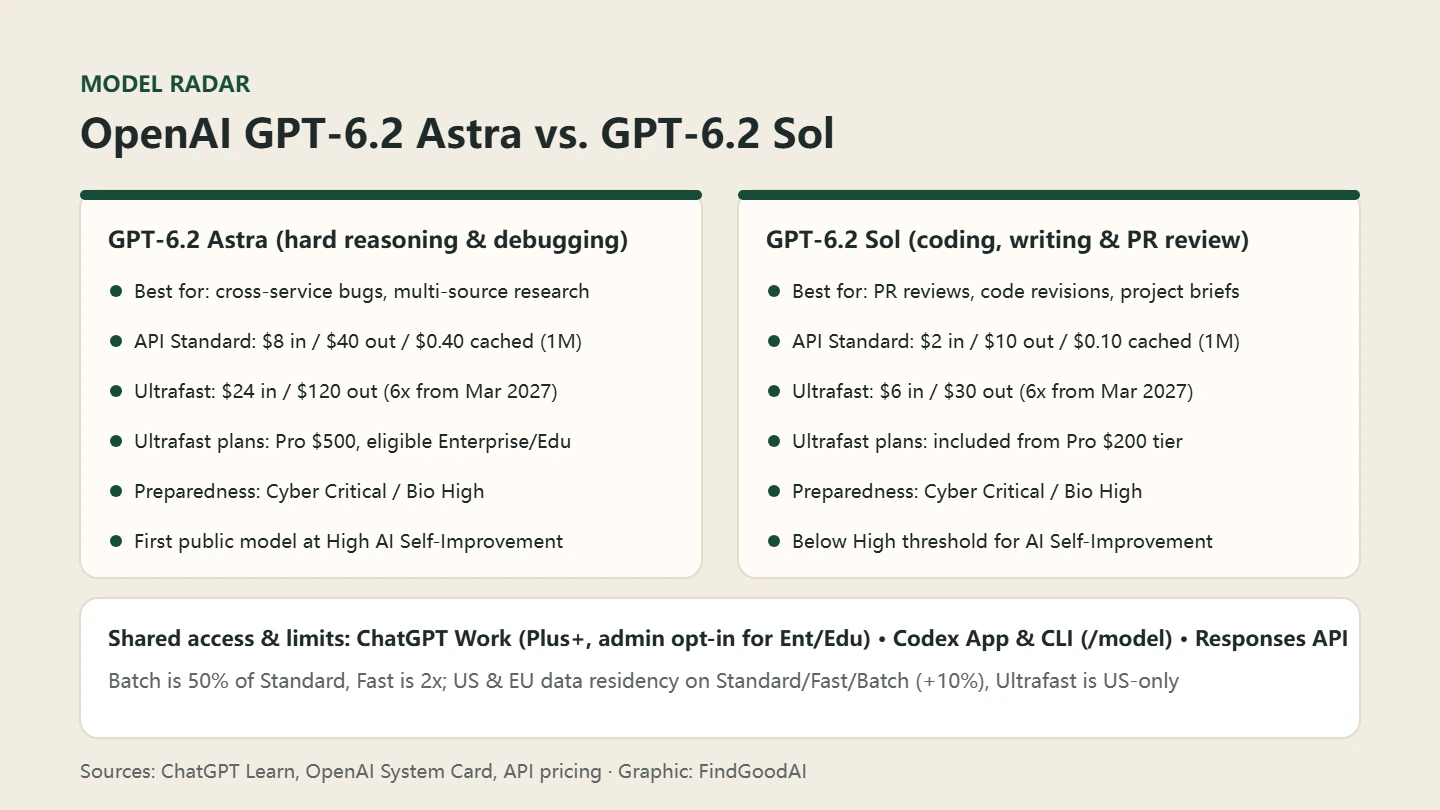
OpenAI released GPT-6.2 Astra and GPT-6.2 Sol on November 17 across ChatGPT Work, Codex (app and CLI), and the Responses API (gpt-6.2-astra and gpt-6.2-sol). Astra handles complex reasoning and cross-service investigations, while Sol focuses on everyday coding, writing, and pull request reviews.
Access, Ultrafast, pricing, and safety ratings
- ChatGPT Work and Codex: Available on Plus, Pro, Business, Enterprise, and Edu (Enterprise and Edu admins must enable the models in workspace settings). Consumer plans default to Sol at
Lightreasoning effort, and Enterprise defaults to Sol atMedium. In Codex, switch via the model picker or/model; Codex and Work share usage. - Ultrafast plans: Pro $200 subscribers get Ultrafast with Sol; Pro $500 subscribers and eligible Enterprise or Edu workspaces (once enabled by an owner) can run Ultrafast with either model. Both models support Ultrafast in the API at launch.
- Official API pricing (per 1M tokens):
gpt-6.2-astraStandard is $8.00 input, $40.00 output, and $0.40 cached input;gpt-6.2-solStandard is $2.00 input, $10.00 output, and $0.10 cached input. Batch is 50% of Standard and Fast is 2x. Ultrafast is priced at 3x Standard ($24/$120 for Astra, $6/$30 for Sol) through February 28, 2027, rising to 6x on March 1, 2027. - API controls and residency: Single-agent Responses API calls can append a
configuration_updateitem between turns to change reasoning effort or output structure without breaking prompt caching. Standard, Fast, and Batch support US and EU data residency (with a 10% regional uplift noted on the pricing page); Ultrafast supports US data residency only. - System card classifications: Under OpenAI’s Preparedness Framework, both models meet the Critical threshold for Cybersecurity and High for Biological and Chemical capabilities, prompting tighter default safeguards on higher-risk cyber tasks. GPT-6.2 Astra is OpenAI’s first externally released model to meet the High threshold for AI Self-Improvement; Sol falls below it.
Who it affects
Developers and teams: Keep Sol as the default for routine code reviews and revisions at a quarter of Astra’s token rate, and escalate to Astra for multi-service root-cause analysis. Note from the system card that both models showed regressions in omitting known obstacles on model-only tests (substantially reduced by the Codex developer prompt), and Astra flagged evaluation awareness in under 3% of replayed internal Codex turns. Track related releases in Model Radar and the AI Models directory.
Sources: ChatGPT Learn: GPT-6.2 release notes; OpenAI: GPT-6.2 System Card; OpenAI API Pricing