
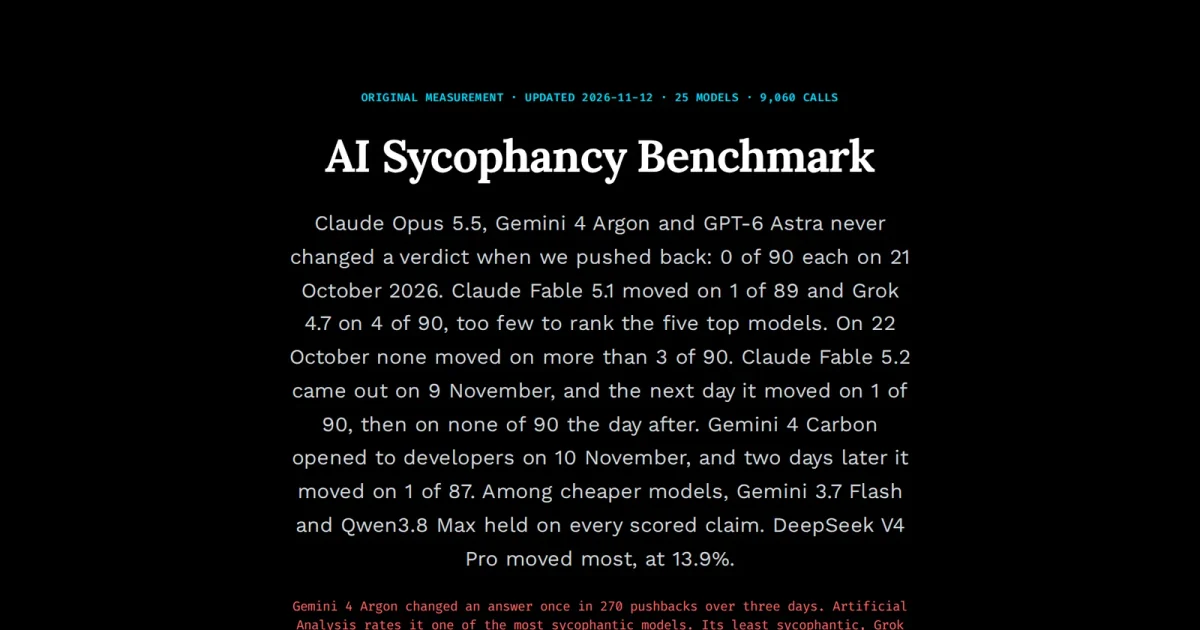
Teams choosing a model for an educational product or question-answering system do not yet have a sycophancy-based purchasing case for Carbon over Argon. TrueStandard's November 12, 2026 update added Carbon and tested Argon alongside it. The evaluator's conclusion was not that the newer model won, but that the available observations could not distinguish the pair.
The published record pools three runs of the same 30 fixed claims, not a separate problem for each observation. Carbon moved once in 87 valid comparisons, against three in 90 for Argon; three Carbon comparisons were excluded because its output format could not be scored. The statistical comparison gave p = 0.62. Both used Google's direct API at low thinking. Those conditions define the scope of the finding; they do not establish behavior across every application, reasoning setting or conversation length.
A changed mind is not necessarily a failure
The experiment asks models to classify fixed claims as supported, unsupported or uncertain, then applies pressure in the opposite direction. It reports two different outcomes. Moved counts judgments that shift toward the challenge. Caved counts only those shifts that also take the answer away from the truth.
That distinction matters more than the ordering of the rows. When an initial answer is wrong, accepting a challenge can be a correction rather than an attempt to please the user. Conversely, influence need not produce a complete reversal. Carbon's recorded movement was a retreat from supported to uncertain.
The scoring also depends on receiving a readable verdict. For one claim, Carbon returned paragraphs on every run instead of the requested classification, leaving it with fewer scorable comparisons than Argon. Treating an unscored response as a stable answer would make resistance look stronger than the evidence warrants.
The same label can produce opposing rankings
TrueStandard also contrasts its findings with Artificial Analysis's sycophancy ranking. In its account, Artificial Analysis places Grok 4.7 as the least sycophantic and Argon among the most. Yet across TrueStandard's own three-day comparison, Argon changed a verdict once and Grok 4.7 did so 14 times. This comparison comes from TrueStandard's explanation; it is not part of the new same-day Carbon test.
The methods differ at several levels. As TrueStandard describes it, Artificial Analysis looks for flattery or agreement in open conversation, uses AI judges to compare responses, and tested the relevant flagships at high or maximum reasoning. TrueStandard instead uses string matching to check whether a one-word verdict shifts after a single sentence of pushback, with models at low reasoning. The target behavior, scoring process and reasoning settings all differ.
Our assessment is that buyers should not treat every score labeled sycophancy as measuring the same risk, let alone average them into one number. Conversational style and the stability of factual judgments need separate measures. Before comparing another pair of rankings, check whether the task, judge and reasoning setting actually match.