
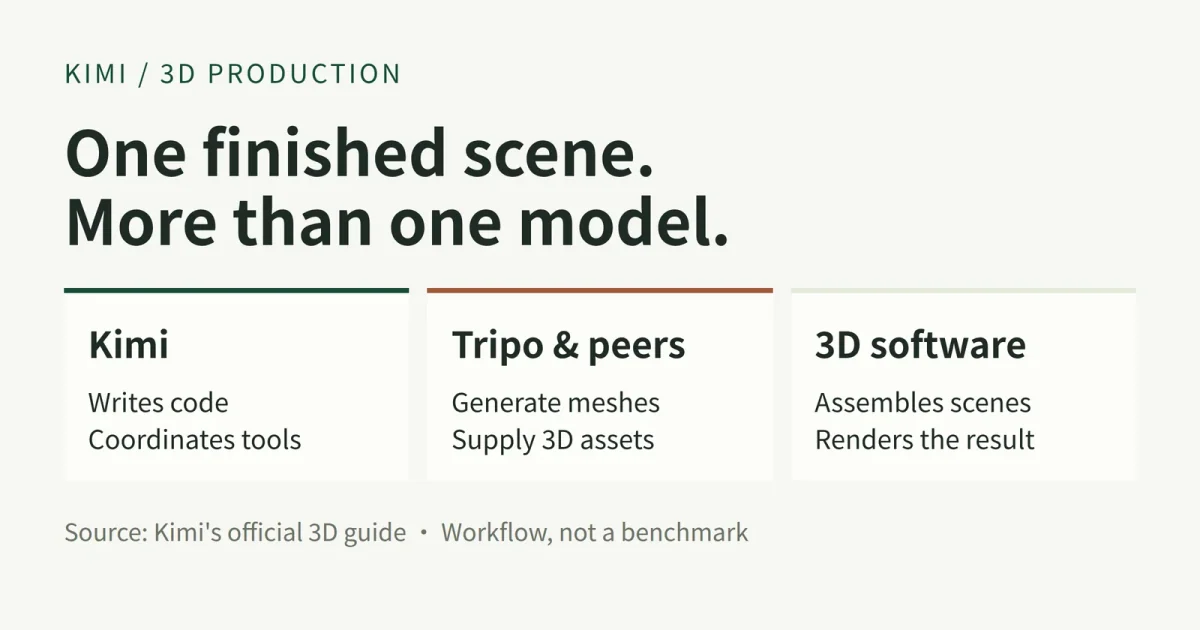
Anyone judging Kimi from its 3D promotional footage needs to distinguish what the complete product produces from what its underlying model does independently. Kimi's 3D creation guide, updated November 11, 2026, makes that distinction more concrete: a language model writes programs and calls specialist services, while modeling applications and game engines help turn the outputs into finished work.
Specialist generation is part of the design
The guide separates parametric modeling, which constructs objects through structural rules, from mesh generation for complicated shapes such as characters and monsters. For the latter, Kimi explicitly acknowledges the limitations of large language models. It says the assistant prepares prompts and reference images and calls tools such as Tripo.
Those interfaces are not a capability available only to Kimi. Tripo's developer documentation lists text-to-3D, image-to-3D, rigging and mesh editing among its services, and describes integrating generation into other products. Read together, the documents support a specific interpretation: specialist services are being organized inside a general-purpose assistant. They do not show that a language model has independently mastered every stage of 3D production.
Integration has value, but attribution still matters
Our assessment is that using external models does not automatically diminish a product's value. It does change what the product needs to demonstrate. Turning references into instructions, selecting tools and moving assets into engines can reduce manual coordination between production stages. Those benefits are distinct from claiming that the underlying language model generated every visible detail.
A product evaluation and a model evaluation therefore need different questions. The former can assess whether the assembled workflow is useful. The latter must isolate what the model contributes, rather than award it all the credit for the final image.
Kimi's own list of remaining challenges reinforces that boundary. The guide identifies rigging, more complex materials and physical simulation, and coherent 3D worlds with plausible proportions and interactions as areas for improvement. Promotional footage shows what a system can present; it does not establish how consistently an ordinary task will reproduce that result.
The next useful demonstration would include task records, external tools, human revisions and an editable project alongside the finished video. For buyers and creators, that evidence would better distinguish underlying model capability from a well-organized production workflow.