
Teams choosing coding models by response time have a reason to examine NaiveAI, but not to declare a new overall winner. A shorter wait on a typical request does not establish an equal advantage across a batch of work. Latent Space's November 10 launch of a new review series, comparing Naive-N0.5-Flash with DeepSeek and GLM, makes that distinction unusually clear.
The median leads; the mean does not pull away
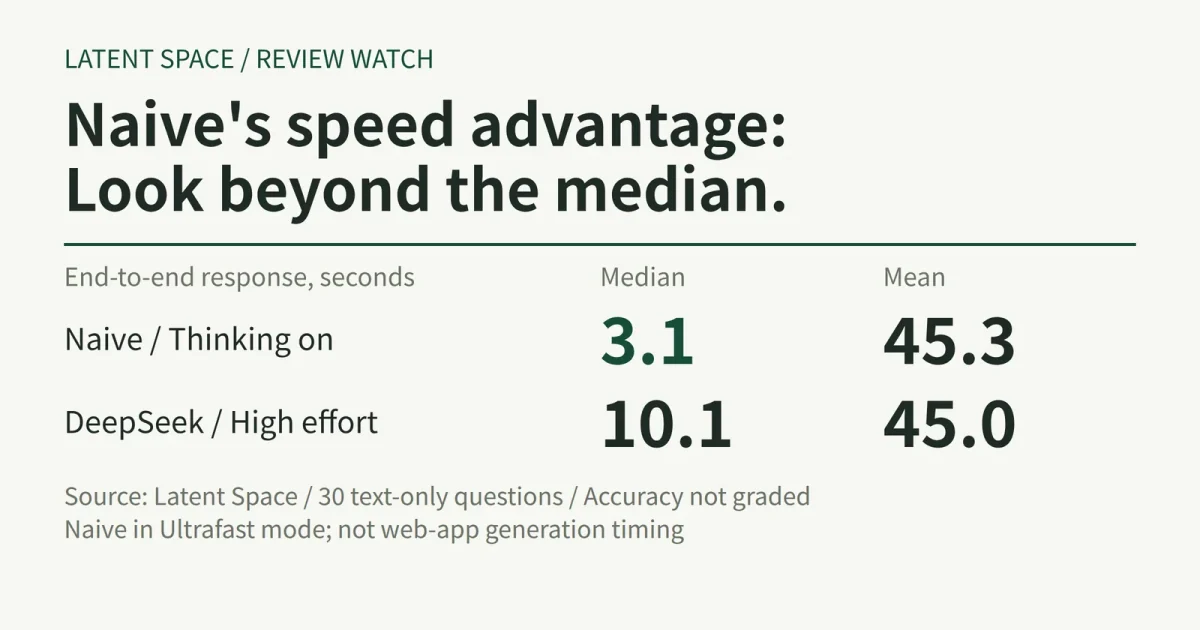
The review tested Naive in Ultrafast mode, a setting independent of the thinking switch, not a measure of Standard-mode performance. Its timing experiment randomly sampled 10 text-only questions each from MATH-500, GPQA-Diamond and HLE-Diamond, for 30 in total. Those were separate from the web-app experiments, not measurements of coding-task latency. With thinking enabled, Naive's median end-to-end response time was 3.1 seconds. GLM 5.3 Flash at high thinking effort took 5.3 seconds, while DeepSeek V4.1 Flash 1017 at high took 10.1 seconds.
The averages tell another story: 45.3 seconds for Naive, 45.0 for DeepSeek and 86.9 for GLM. A small number of exceptionally long reasoning traces pulled Naive's mean upward. For an interactive application, the median offers useful information about typical waiting. For a system processing batches, slow requests also matter. That is our reading of the statistics, not a deployment benefit demonstrated by this experiment.
There is a harder boundary around the evidence. Each difficulty level had only a small sample, and the timing experiment did not grade correctness. It measured how these requests consumed time, not how long each model needed to complete a task correctly.
A decoding peak is not a capability ranking
NaiveAI's technical account supplies another qualification. NaiveRT's 2,122 tokens/s result is a single-stream decoding peak over the best one-second window, using 8 GPUs with thinking disabled and excluding prefill. It is not interchangeable with the time a user waits between submitting a question and receiving a complete answer.
The measurement paths also differ. Latent Space obtained Naive's throughput figures from server-side measurements, while the other models' figures came from OpenRouter. It explicitly declined to claim an exact speed multiple. Putting those measurements in adjacent columns does not make them directly divisible.
Our assessment is that Naive's competitive proposition here is the combination of a model and its inference system, rather than a demonstrated lead across capabilities. The company describes adapting MiMo-V2.5 and pairing the resulting model with its own runtime. For buyers, that makes the serving implementation part of the comparison, not merely an incidental detail behind the weights.
The next useful evidence would repeat the tests through consistent request paths and acceptance criteria, publishing error rates alongside slow-request behavior. Until then, lower latency is a reason to put Naive on a shortlist, not sufficient evidence to replace a production system.