
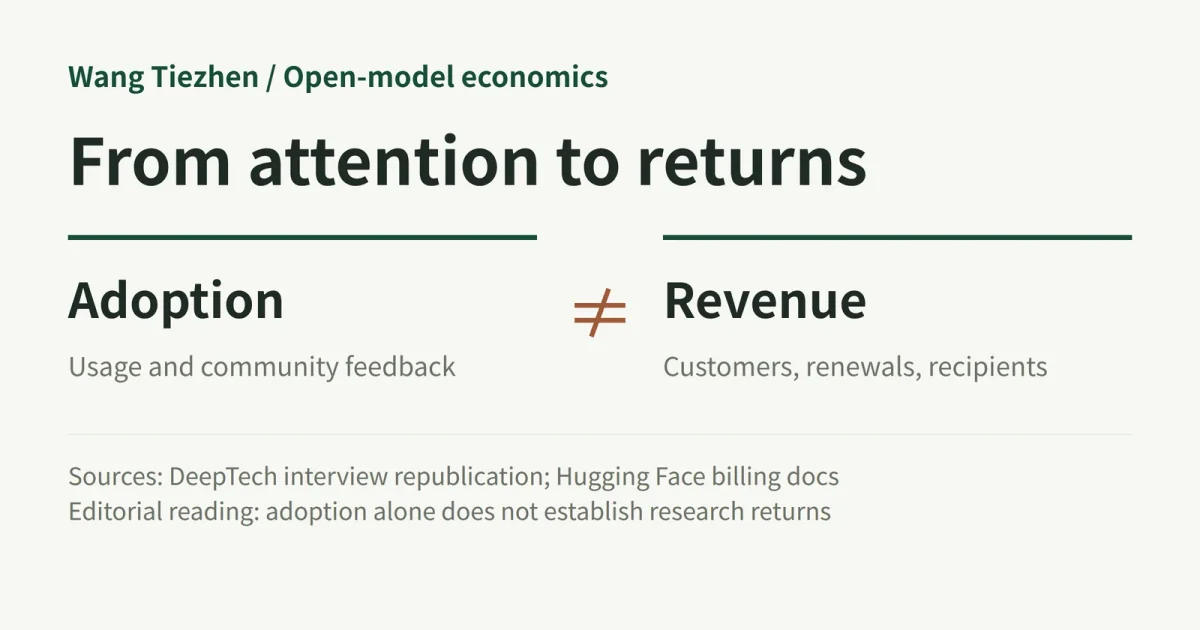
A model developer deciding whether to release weights needs more than evidence of launch-day interest. In a public republication of a DeepTech interview dated November 13, Wang Tiezhen argues that open releases are finding it harder to attract attention, and that releasing more assets does not necessarily solve commercialization for established teams. For model makers and businesses around them, adoption and the destination of revenue are separate questions.
The interview reports that Wang left Hugging Face in May this year for Inferact, founded by the core vLLM team, shifting his work toward the inference ecosystem. He attributes the pressure to an oversupply of models diluting attention and competition from closed-model APIs weakening the price appeal of open models. Those are the competitive concerns behind his bleak assessment, not established evidence of an industry-wide revenue decline.
Collaboration can be open while services carry a price
Hugging Face's billing documentation offers a concrete comparison. The company describes a community collaboration platform that monetizes advanced features and access to compute. Its Team and Enterprise offerings include single sign-on, repository access controls, control over data location and additional storage, with subscription billing.
The saleable item here is not the fact that people like a model. It is computing capacity or an organizational capability that a customer can purchase. Open collaboration and charging for services are therefore not inherently contradictory. Nor must the thing being sold be the model weights themselves.
That example has a firm limit. A service provider listing paid products does not establish that a model author receives a share, or that training costs have been recovered. Combining the economics of hosting providers, model developers and application companies obscures the questions that matter: who funds development, who owns the customer relationship, and who can keep issuing invoices?
Service revenue is not automatically research funding
Our reading is that the useful dividing line is not allegiance to open or closed models. It is whether a business can explain its route to revenue. Community feedback matters when a release is intended to encourage adoption. Funding subsequent research requires another explanation: how adoption becomes payment, and which participant receives it. Success on the first objective cannot stand in for success on the second.
The next useful disclosure would concern paying customers, renewals and where the revenue goes, rather than another popularity ranking. Until model teams provide that evidence, adoption and commercial viability should be evaluated separately.