
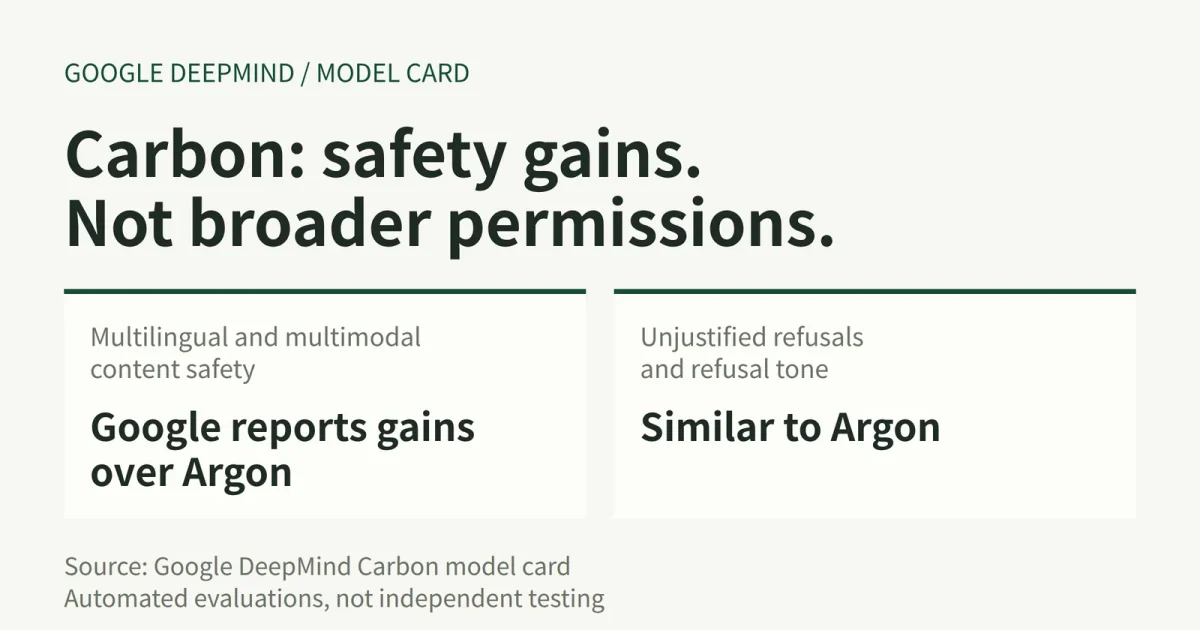
Teams choosing a writing model should draw a narrow conclusion from Gemini 4 Carbon's latest safety disclosure: Google reports content-safety gains, not broader content permissions. In its model card published November 10, Google DeepMind says Carbon outperforms Argon across multilingual and multimodal content safety overall, while unjustified refusals and refusal tone remain similar.
A false refusal and a content restriction measure different things
An unjustified-refusal test asks whether the model blocks requests it could safely fulfill. A content-safety test asks whether it follows safety requirements. Keeping those questions separate matters: a model can become better at recognizing permissible requests without expanding the set of activities its provider permits.
The distinction also changes how successive releases should be read. The Argon model card published October 13 emphasized substantially fewer unjustified refusals and better refusal tone relative to Gemini 3.1 Pro. Carbon's summary describes those aspects as similar to Argon's. An improvement reported for the earlier release cannot simply be counted again as a new opening in Carbon.
The safety gains come with a comparison limit
Google labels some of Carbon's reported safety results as automated evaluations, rather than human evaluations or red teaming. It also warns that updated evaluation methods make the results unsuitable for direct comparison with figures in earlier model cards. Combining changes from different pages to infer that a particular genre is becoming easier to generate would go beyond that evidence. The useful comparison is the one Google reports within the current card, rather than a trend reconstructed by adding figures from separate releases.
The company separately reports human red-teaming findings, including that Carbon met the required launch thresholds for child safety. It reports similar or improved performance against content-safety policies generally compared with Argon. These are vendor assessments of safeguards, not independent evaluations.
For product positioning, the more consequential evidence is whether the rules have changed. Carbon's acceptable-usage section still refers to Argon, whose guidance includes restrictions on integration into systems engaging in sexually explicit activities. Our reading is therefore behavioral calibration between safeguards and usability, not a documented move into the adult-creation market.
Evidence for such a shift would require checking for revised acceptable-use guidance, explicit support in a named product and reproducible, task-specific evaluations.