
For teams building chat products, DeepSeek is offering more than the model that produces an answer. Its November 13, 2026 application API release exposes search, document processing and speech components that help deliver the conversation around it. The purchasing decision now extends from inference to services used in completing a task.
Search was already available; the packaging has changed
DeepSeek's official changelog dates the opening of its in-house search API to October 17, 2026. Describing this release as the first opportunity for outsiders to call its search service would therefore miss the distinction.
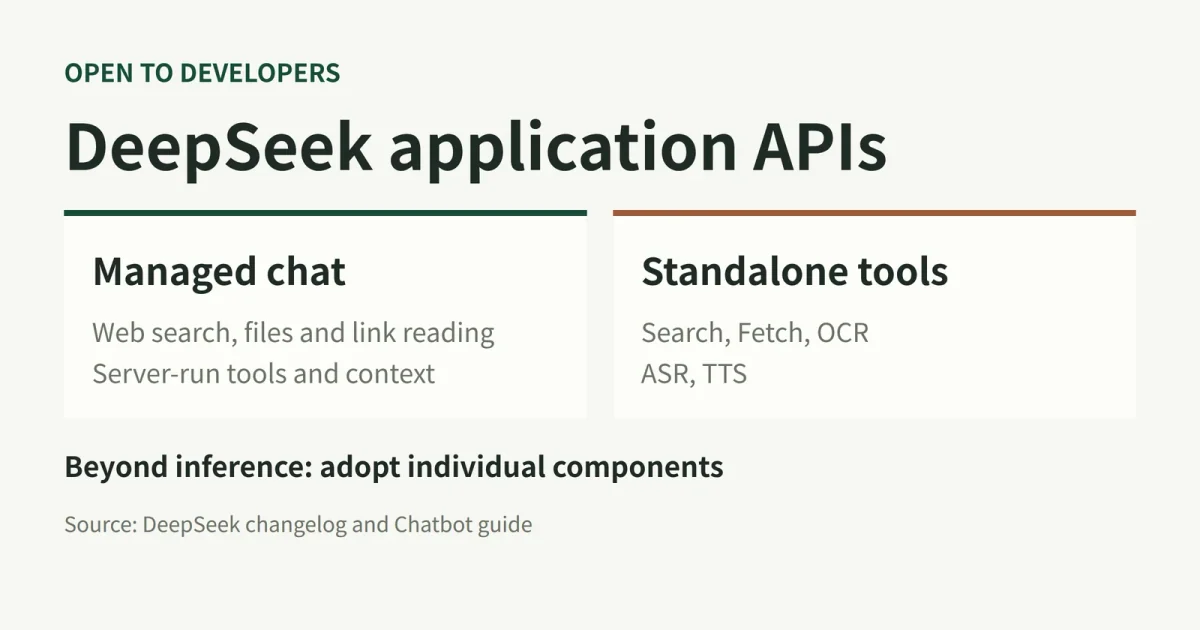
The newer offering puts application features inside existing conversation requests, with DeepSeek handling tool execution and context assembly. It also exposes additional capabilities as independent services. That creates two adoption routes rather than a single requirement to use the full chat stack.
A team seeking less orchestration code can choose managed conversations with web access and file input. A team with its own workflow can instead buy retrieval, page fetching, OCR, speech recognition or speech synthesis as components. It need not move its entire application just to use one of them.
DeepSeek has also open-sourced a demonstration chat client showing how the components fit together.
Managed execution changes the boundary of control
The integration guide supplies a concrete example of that trade-off. Activating certain application features causes some developer-specified generation parameters to be ignored and determined by the server instead. Less orchestration work comes with less control over parts of execution.
Our reading is that the dual route matters commercially more than the feature inventory. Managed conversations can capture the work of an entire interaction. Independent endpoints can reach applications that do not adopt DeepSeek's complete chat offering. This separates purchasing decisions: a new project can compare complete conversation services, while an established application can evaluate suppliers component by component without first deciding to replace its main model.
The price structure reinforces the component approach: model use is billed by tokens, retrieval and fetching by calls, document processing by pages, and speech by characters or audio duration. Search has the same unit price whether invoked directly or by the model. Comparing inference prices alone would therefore omit part of the task bill.
The useful next test is to run the same tasks through managed conversations and a self-orchestrated workflow, comparing total cost, failure handling and the ability to trace answers to their evidence.