
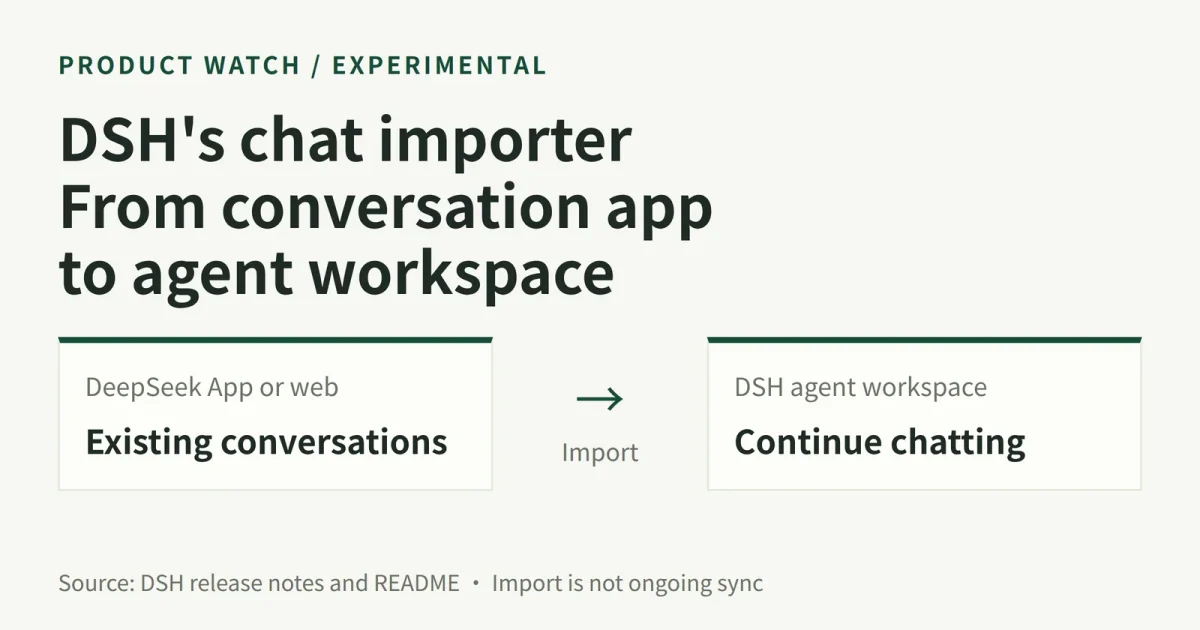
For people with substantial discussions already stored in DeepSeek, adopting an agent tool means more than learning another interface. It can mean explaining the task again. DSH's November 13 release, v0.2.2-rc.3, begins to address that barrier with an experimental plugin that brings previous App or web conversations into a workspace for further discussion. The change concerns where work begins, not a newly announced model capability.
From adding workspace capabilities to connecting an entry point
The contrast with the preceding release is useful. DSH rc.2 added code review organized by branch, commit and file category, alongside named, multi-level subagent collaboration. Those additions primarily expanded what users could do after arriving in DSH. The importer instead addresses the discussions they have already had elsewhere.
Our reading is that carrying existing context forward has more product significance than simply offering another chat window. If the transfer preserves the relevant material, requirements developed in an earlier discussion could remain available for subsequent work, reducing the burden of restating them. The announcement supplies no test results for migration fidelity or task quality.
The approach also fits the project's stated design. DeepSeek describes DSH as an open-source agent harness built around plugins. This particular connection runs between DeepSeek's own conversation products and its agent environment. It does not establish that DSH has become a general-purpose importer for conversations across competing services.
Portable content is not shared application state
The release describes importing history and continuing the discussion, without specifying an ongoing update mechanism. How new messages would propagate after an import, and how changes on either side would be reconciled, remain open questions.
There are separate maturity signals to consider. The release is designated a pre-release, and the importer itself is labeled experimental. The same update fixes Windows in-app upgrade failures and problems reopening automatically. Expanding the product's entry points is happening alongside repairs to desktop reliability.
The next useful signals are documentation defining exactly what conversation content is preserved and release notes specifying any continuing synchronization mechanism. The former would establish whether old discussions can be reused reliably. The latter could keep context aligned automatically and reduce repeated migration work. Without ongoing sync, manual imports or staged handoffs could still support work across interfaces.