
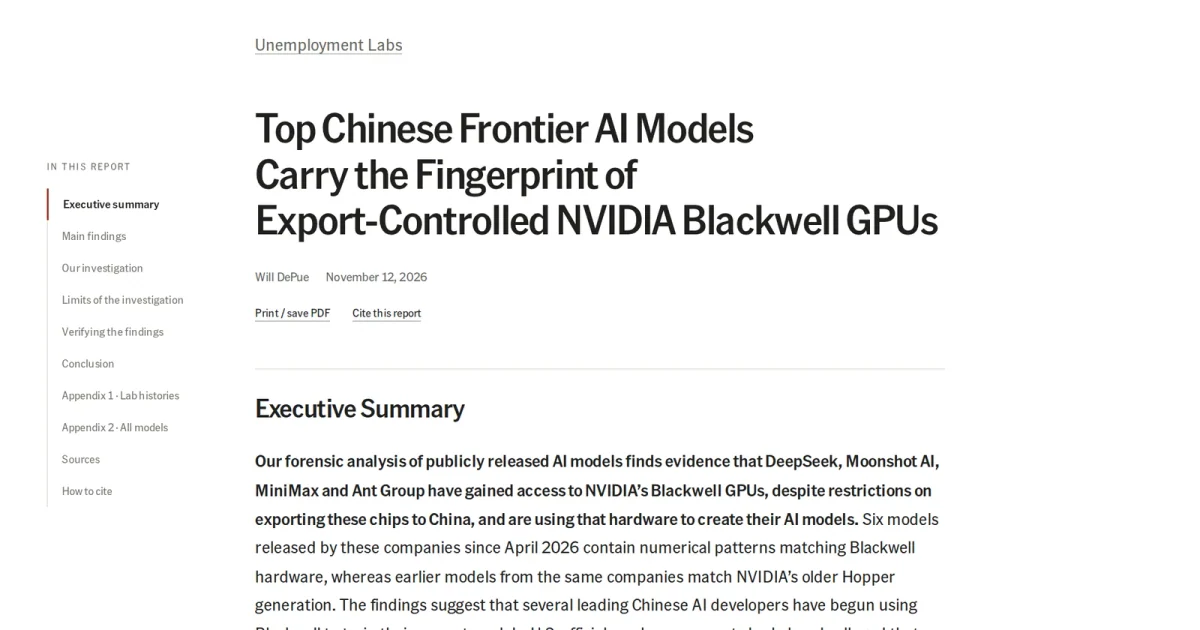
Assessing Chinese AI developers' access to export-controlled computing hardware now has another testable input: numerical traces in published model weights. Unemployment Labs released a report on November 12, 2026 linking six models from four Chinese developers to Blackwell, hardware whose export to China is restricted, as the report notes.
Will DePue's report covers models from DeepSeek, Moonshot AI, MiniMax and Ant Group. The technique searches for a random seed and parallel-thread arrangement that reconstruct surviving initialization values. Some weights remain almost unchanged; others retain only a faint correlation with their starting points. This is not the equivalent of reading a chip's serial number.
The generational change is concentrated in some developers
The report associates DeepSeek V3, released in December of 2024, with Hopper, and the V4 models released in April of 2026 with Blackwell. It does not find the same transition everywhere: the newest readable models from Alibaba's Qwen and Zhipu's GLM, among others, still match Hopper. Our assessment is that, if independently reproduced, these initialization findings would argue against assuming uniform hardware access when comparing Chinese model developers.
Rejecting chance is not the same as eliminating every alternative
The largest reported result is 1,385 sigma. Within the author's statistical model, it measures the distance from resemblance expected by chance. Testing weights withheld from the search helps assess whether the match extends beyond the data used to select it. Neither step converts the score into a probability that Blackwell alone could have produced the pattern.
Nor is the investigation devoid of hardware comparisons. DePue reports agreement with 24 model cases in which developers disclosed their equipment, alongside reproduction checks on physical chips. But an unusually configured AMD MI300X can generate the relevant layouts too. For DeepSeek-V4-Flash, the author uses finer numerical differences to rule out that alternative; the same test does not resolve the other five models.
The missing link is what happened after initialization
The recovered trace concerns the creation of starting weights. As the report acknowledges, a developer could transfer those weights to another system or continue an existing model's training on different equipment. Establishing which chips carried out the whole run therefore needs additional records. Ownership, physical location and the route by which access was obtained also remain outside what these numbers reveal. The weights alone do not establish smuggling or an export-control violation.
The PyTorch guidance on reproducibility supplies useful context: exact reproduction is not assured across versions, commits or platforms. That warning neither validates nor refutes this investigation. It explains why a forensic identification must be tied to a defined software environment rather than treated as a universal identifier.
The next substantive development would be independent reproduction of the individual findings and broader testing of alternative configurations, not another repetition of the highest sigma score.