
For developers who keep an AI coding project in one continuing conversation, being able to return to work after a failure matters more than how responsive an empty chat feels. A new public DSH report raises that distinction: restoring previous work can become a liability if it repeatedly brings the application back to the state that caused it to fail.
A new failure path, not a settled diagnosis
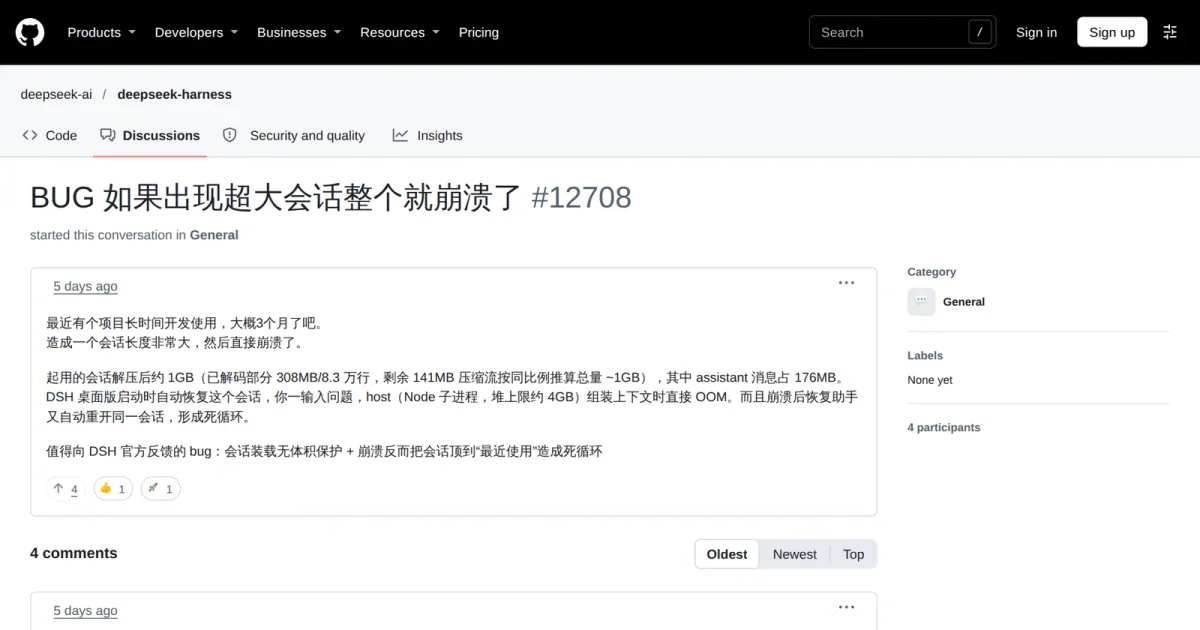
On November 9, 2026, a discussion in the DeepSeek Harness repository described an oversized conversation estimated at about 1GB after decompression. That figure was extrapolated from partially decoded data, not independently measured. The author reports that submitting input after automatic restoration exhausts backend memory, after which recovery opens the same conversation again.
The limits of that evidence matter. The public thread does not supply sufficient version details, system information or inspectable logs, and contains no maintainer-confirmed resolution. It cannot establish a problem affecting every desktop installation. Nor is memory exhaustion, by itself, proof of a memory leak.
What the report adds to earlier complaints is a specific question: does recovery repeatedly trigger the failure? An older performance discussion included an account of an unresponsive client with a working backend. Synthetic testing in that thread also cautioned that event counts alone did not predict processing costs. Together, these accounts justify investigating separate layers, not assigning every long-session symptom to one cause.
A different interface is not necessarily a different system
The official architecture reference describes Desktop as an Electron shell around the complete Web application. The dsh-TUI project, meanwhile, highlights event-driven projection, virtualization and bounded caches while explaining that DSH can run as its in-process backend. Presentation technology and the task engine are separate choices.
Our reading is that changing the presentation layer has a plausible benefit for some rendering workloads, but does not automatically address history loading or execution failures. The terminal project's design description is not a controlled comparison with Desktop, either. It cannot establish that the reported crash has been solved by choosing another client.
For maintainers and teams evaluating these tools, acceptance testing should include opening history filled with tool output, continuing the task, and recovering without repeatedly returning to the same failure state. A demonstration of responsive typing in a new conversation answers none of those questions.
The next useful public evidence would be a recovery-path test tied to an exact version and reproducible session: can it preserve the history while breaking the cycle of failed restoration? Until that exists, nearby performance fixes should not be presented as a resolution of this particular report.