
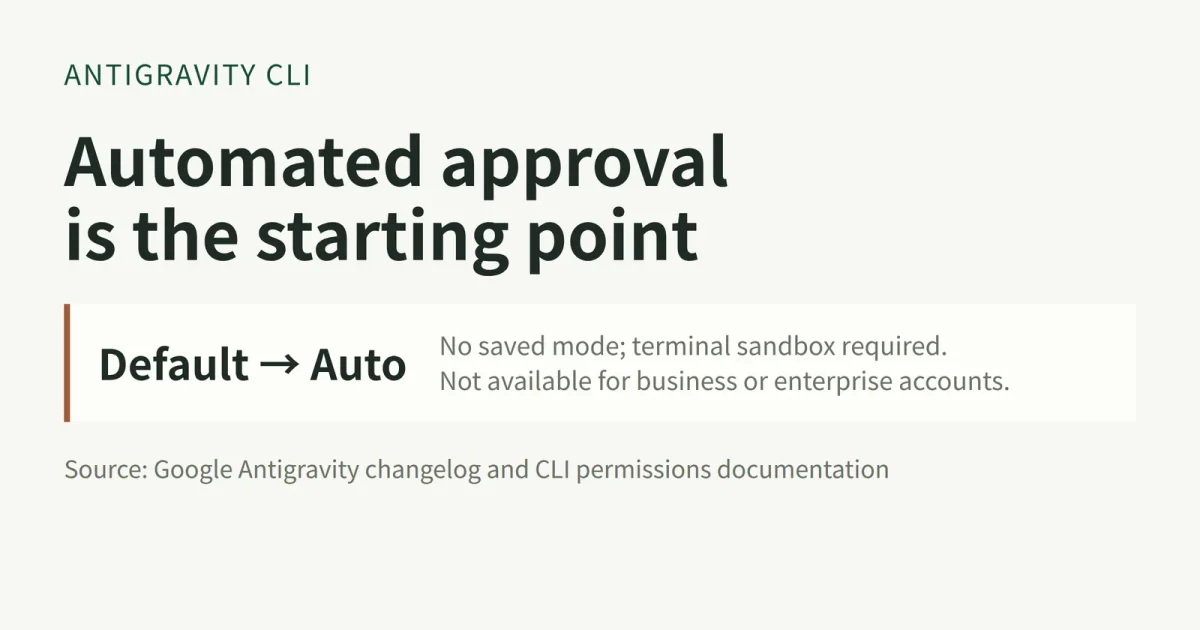
Developers can now enter an automated approval workflow in Antigravity CLI without actively choosing one. Making Auto the starting mode changes what happens when a user leaves the decision unset. For teams maintaining development environments, that deserves more attention than another option in a menu: an untouched configuration no longer necessarily preserves the previous approval workflow.
Google documents the change in its November 12, 2026 notes for CLI 1.5.7. Sessions without a saved mode use Auto where it is available and Default elsewhere, including headless tasks. Auto already existed as an option. The news is its move from an explicit choice to the path taken when no preference has been recorded.
Some approval decisions move to the agent
Google's CLI permissions documentation sets an important boundary: Auto needs the terminal sandbox and is unavailable to business or enterprise accounts. Those accounts should not be counted among the users receiving the new Auto default.
Workspace edits can be approved automatically. Terminal commands normally execute inside a sandbox, while requests to run outside it undergo automatic assessment. Safe, reversible operations can proceed without human confirmation; risky or irreversible actions still pause for approval. The shift concerns who makes the initial decision, not whether a decision exists.
Nor does the mode label replace the permission system. Deny rules outrank Ask rules, which outrank Allow rules. Web access without an applicable authorization, unconfigured MCP tools, and access to files outside the workspace retain their respective approval requirements. Reading Auto as permission for every connected tool would miss those separate controls.
The same release tightens enforced review
The update also repairs cases where a hook's automatic approval or a wildcard allow rule could bypass organization-mandated review. The affected paths include commands held for administrator-required review and certain file operations outside the workspace. The notes explicitly preserve strict permission settings for file edits, too. These repairs concern approval paths governed by organizational policies, not the opening of Auto to enterprise accounts. Less interruption for ordinary work and stronger enforcement of mandatory review appear in the same release, but their scopes should not be conflated.
Our reading is that Google is making fewer manual interruptions a default product choice, while the accompanying fixes show why enforcement of mandatory review needs its own checks. Teams should encode operations that must stop for review as explicit rules rather than depend on every member remembering to change modes. Convenience and organizational authorization need separate acceptance tests.
The useful next check is not how many prompts disappear. It is whether the operations designated for mandatory approval still stop and wait after the update.