
Cognition, the company behind Devin, released the SWE-2 Flash coding model on November 4. It is available now in Devin Desktop and the Devin CLI, free until November 30. It is built on Thinking Machines’ Inkling-Small (276B total, 12B active parameters), from the same lab as last week’s Inkling 2 Small.
What changed
- Training: a three-stage mid-training run over a few trillion tokens came before reinforcement learning, and the RL gains came mostly from higher-quality, more varied tasks.
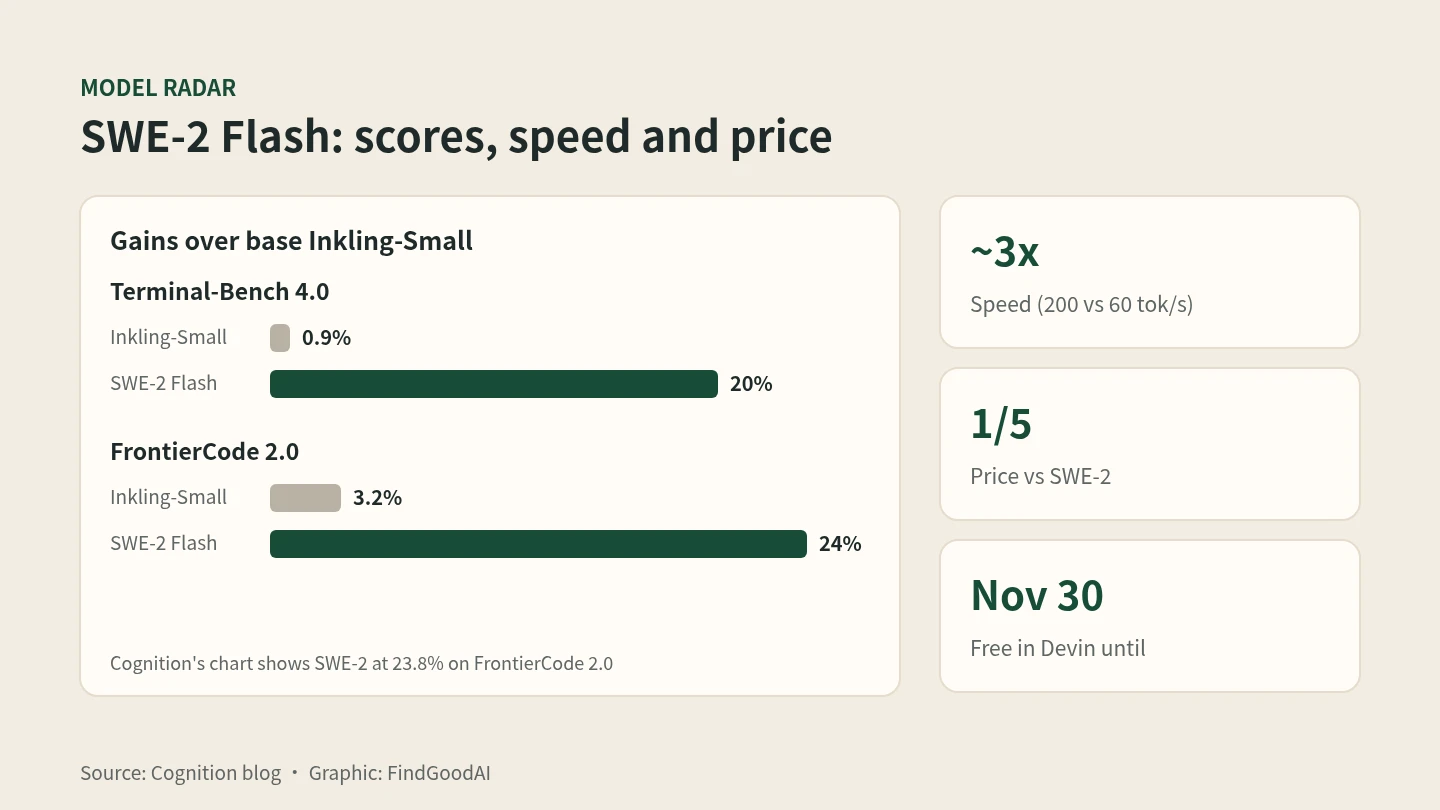
- Gains over the base: Terminal-Bench 4.0 rose from 0.9% to 20.0% and FrontierCode 2.0 from 3.2% to 24.0% compared with Inkling-Small. Cognition’s chart puts SWE-2 at 23.8% on FrontierCode.
- Faster and cheaper: about three times the speed of SWE-2 (200 versus 60 tokens per second in the demo) at a fifth of the price.
- No open weights: Cognition is holding them back over cyber risk and plans to share them only with trusted partners and research labs.
Who it affects
Devin users can hand routine edits and test-writing to Flash for free this month, compare the results with SWE-2 and keep the larger model for harder work. Other developers cannot use it outside Devin yet; Cognition does not mention an API. Cognition calls it a “fully American coding model” that beats every US open-weight model on leading evaluations, which is the vendor’s claim. For an open model released the same week, see Ripple-65B.
Editorial perspective
The interesting part is the recipe rather than the score: a smaller open base model from another lab, plus targeted mid-training and better RL tasks, gets close to Cognition’s own larger model on its coding benchmark. Expect more coding tools to build on licensed or open base models instead of training from scratch. Withholding the weights over cyber risk also matches what OpenAI did with GPT-6 Cyber this week.
Source: Cognition: SWE-2 Flash