Gemini 4 Carbon has a strong launch across independent evaluations, but its initial rollout is restricted. The practical news is both the performance improvement and the conditions under which people can actually use it.
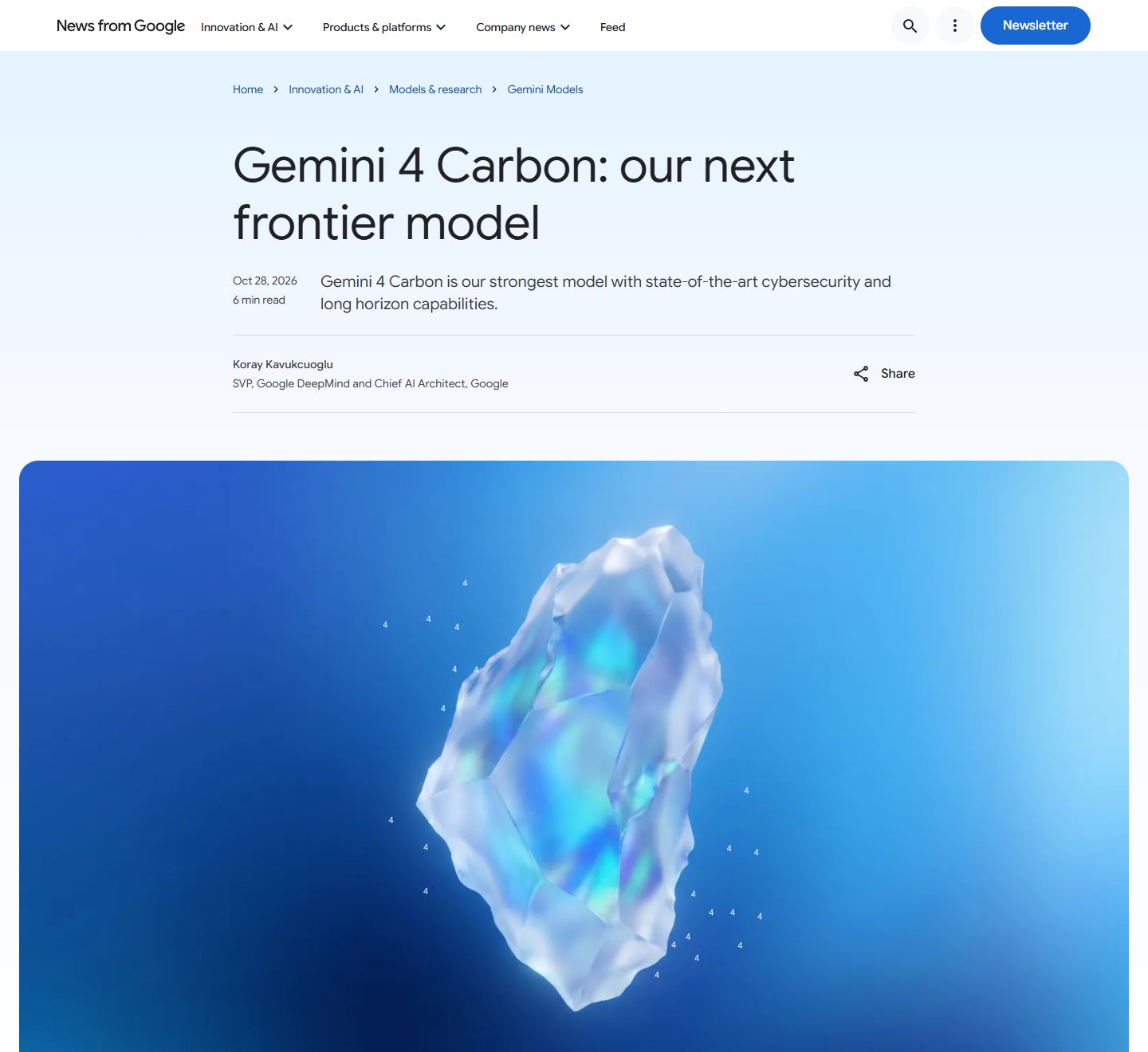
Google announced Carbon on October 28, 2026. Its launch description starts with a subset of cyber defenders and an expansion to trusted partners through Fairwind, with broader availability planned later. A leaderboard entry should not be mistaken for an API that every developer can call today.
What the current Agent Arena shows
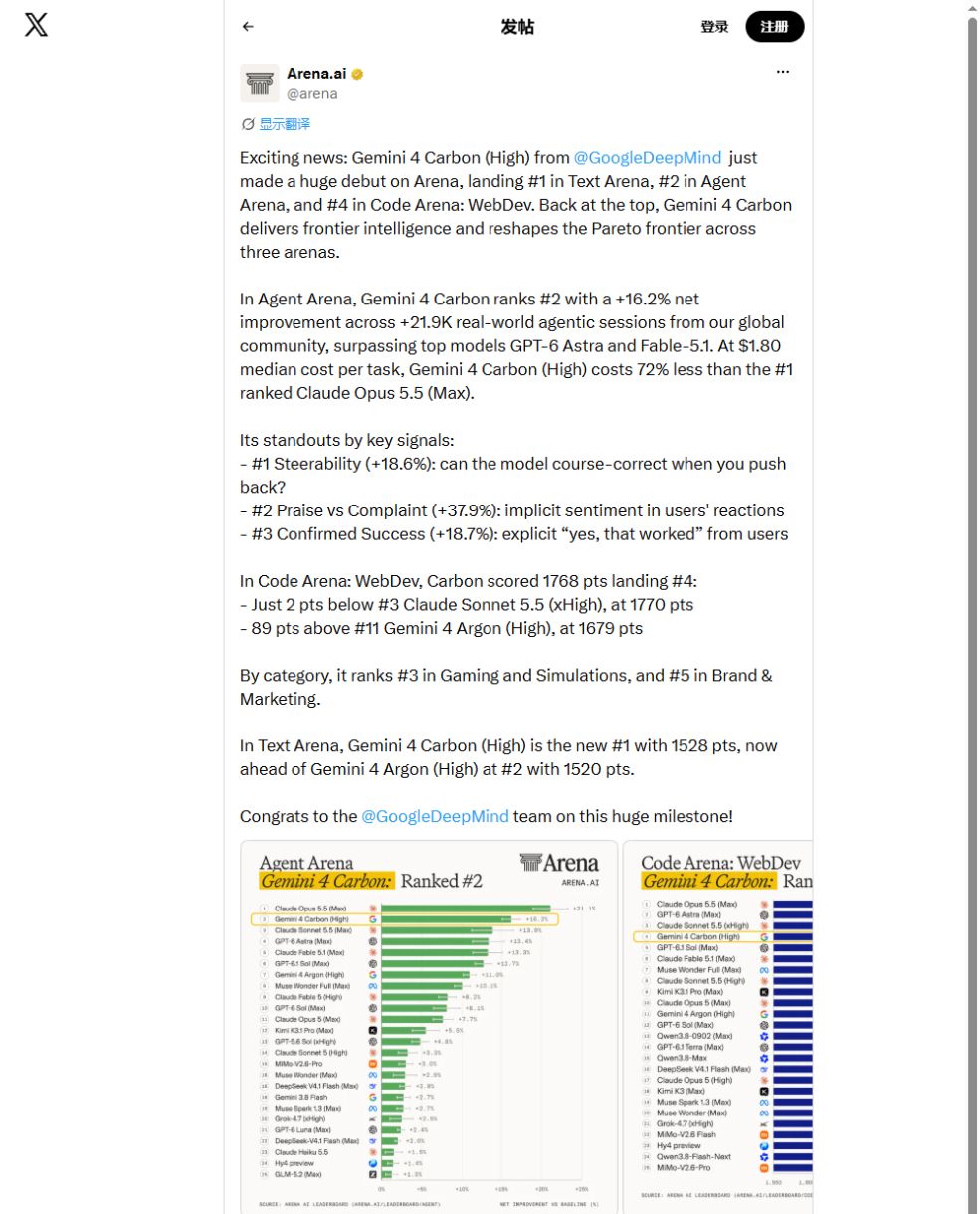
When checked on October 29, Arena’s Agent leaderboard placed Gemini 4 Carbon (High) second and marked it Preliminary. The row showed 26,511 sessions, net improvement of 16.04 ± 1.00 percentage points, a $1.74 median task cost and an 11.4-minute median task duration. Claude Opus 5.5 (Max) was first, with 20.94 ± 2.15 points and a $6.66 median task cost.
Net improvement combines interaction and tool-reliability signals against an average-model baseline. It is not the percentage of tasks completed successfully. Arena’s task-cost measurement considers up to the first three tasks in a session, so its median is also different from a fixed price for an API request.
A broad advance, without sweeping every benchmark
Artificial Analysis put Carbon first in its Intelligence Index at 59. Google’s comparison table reports 61.2% on FrontierSWE 2, up from Argon’s 55.0%, while GPT-6 Astra and Claude Opus 5.5 are listed at 65.5% and 62.3%. On the 82-task offline subset of OSWorld-2.1, Carbon’s partial score of 81.5% remains below Opus’s 87.2%.
These results support taking Carbon seriously for agent and coding evaluation. They also show why an overall lead does not mean first place in every task. An index, a software benchmark and a desktop-control benchmark measure different things.
Price and access need separate checks
Google lists introductory token prices of $2 per million input tokens and $10 per million output tokens, rising to $4 and $20 after the introductory period. The announcement does not give that period’s end date. Those token prices should not be substituted for Arena’s observed task costs: a task may involve multiple calls and tools.
The first step is to establish access through the announced rollout. A model page, a third-party provider count or a benchmark appearance does not establish that a particular account can use Carbon. Teams can prepare representative tasks now and validate the actual endpoint, available settings and limits when access is granted.
Why the original announcement image has different numbers
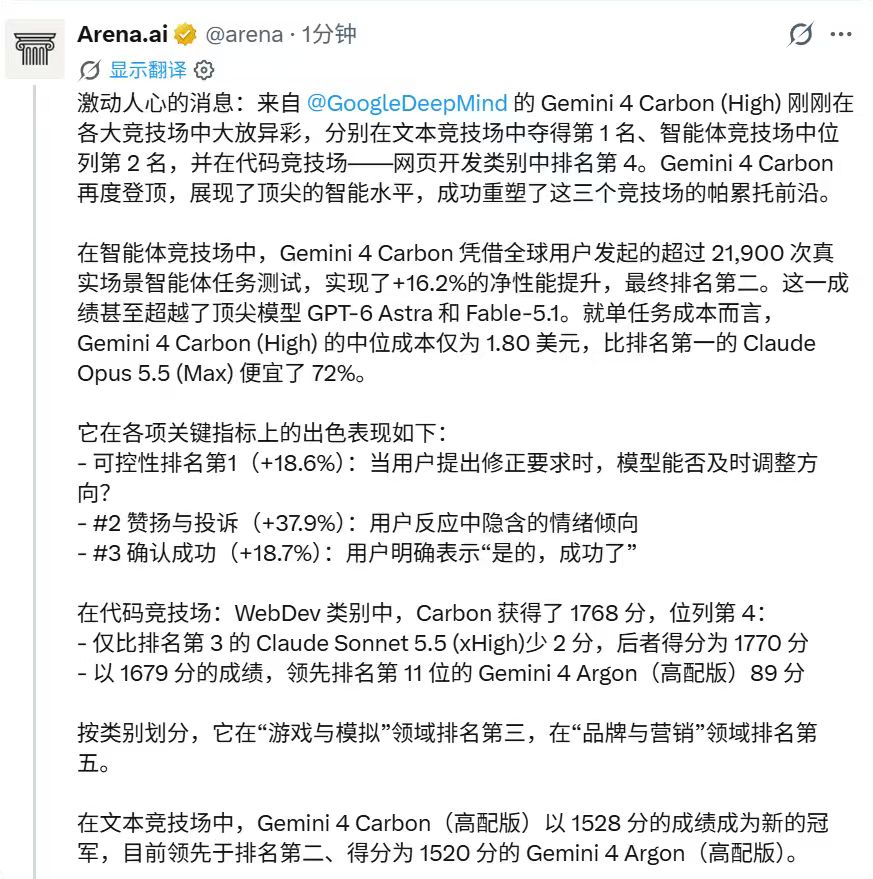
Arena’s original post reported more than 21,900 sessions, +16.2% net improvement and a $1.80 median task cost. The screenshots below preserve that launch snapshot. The newer figures above come from the leaderboard checked on October 29; they are not edits to the original post.
For a deeper decision framework, read our team evaluation guide covering latency, factual reliability and cost per accepted task. The earlier Arena reading guide remains available as background.
Arena launch screenshots in English and Chinese