JetBrains Junie
CodingJunie combines a coding agent with planning, model choice and JetBrains development workflows. Use the CLI, supported IDE integration or repository automation to work on scoped code changes.
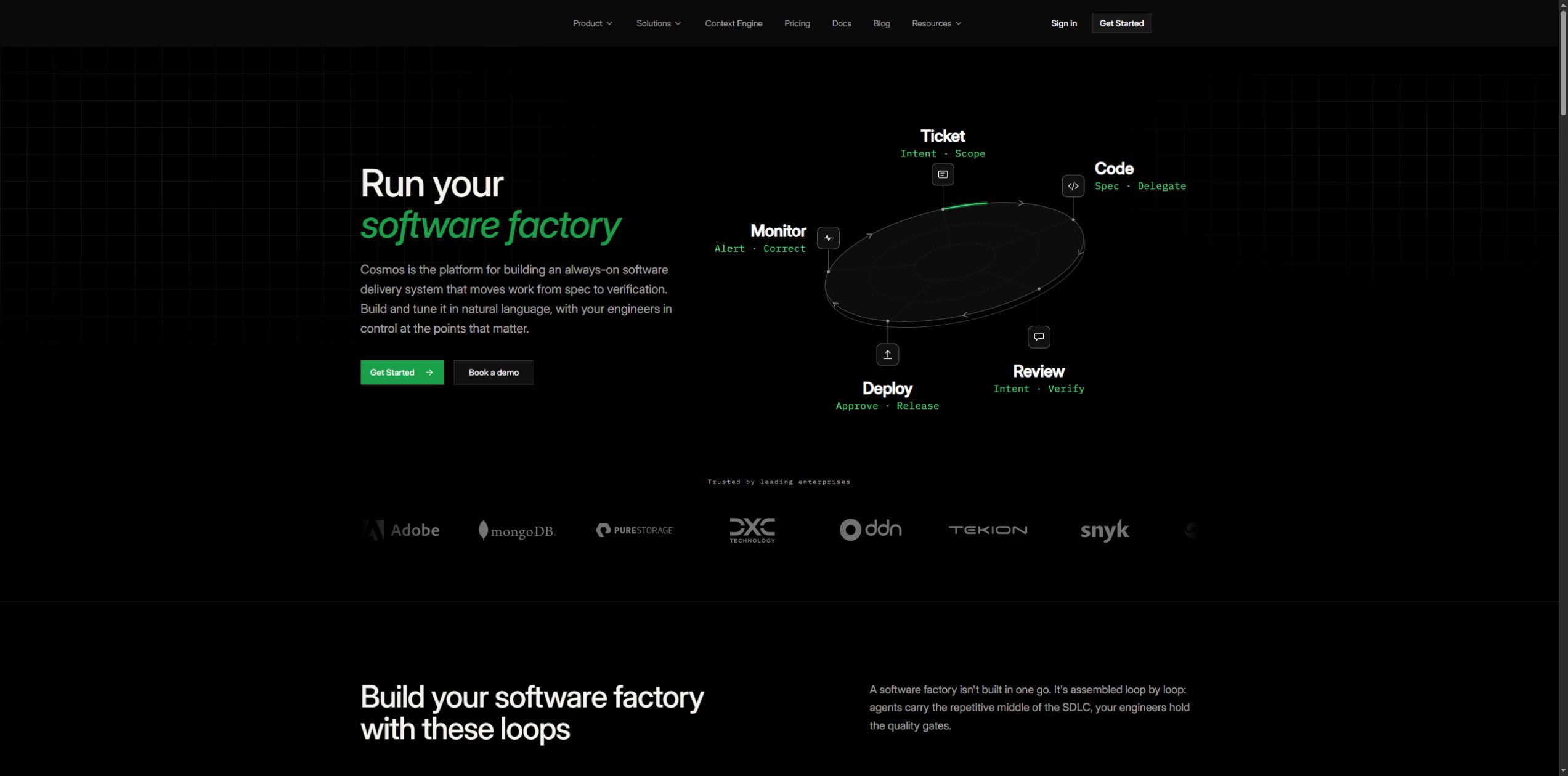
Augment connects codebase context with coding, review and cloud-agent workflows. Its current Cosmos platform coordinates repeatable engineering work with human review checkpoints.
Augment is aimed at engineering teams whose work extends beyond a single prompt in an editor. The current site emphasizes Cosmos: a place to connect agents, repository context, task triggers and approval points. A task can move from a ticket to a proposed code change and review without losing the surrounding project context.
The sensible adoption unit is one repeatable workflow. Try a class of maintenance tickets or a review queue, define a successful output and inspect several runs. Broad automation is much harder to judge when ownership, test environments and escalation rules have not been established.
Triage a recurring bug class
Prepare a dependency upgrade
Reduce review preparation
Official product image. Click to inspect the details.

The Context Engine is central to Augment’s product. Evaluate it with questions that require following real call paths and team conventions, not just locating a symbol by name.
Assign bounded engineering work and receive a proposed change. Include a concrete acceptance example so the agent has a target beyond merely producing a pull request.
The official cloud-agent page describes sandboxed execution connected to code and tools. Review the returned pull request, evidence and environment assumptions before integrating it.
Cosmos organizes reusable agent roles and workflows triggered by engineering systems or schedules. Start with explicit triggers to prevent unexpected repeated runs.
Review checkpoints are part of the workflow design. Specify who accepts scope changes and who approves repository or deployment actions so responsibility stays visible.
Choose one workflow
Connect limited context
Review the proposed setup
Compare several completed runs
Define the incoming ticket type, expected output and owner. Keep the first workflow small enough to inspect manually.
Authorize only the repositories and services needed for that workflow. Prepare a test environment and sample task.
Inspect agent roles, tools and checkpoints before enabling a trigger. Make failure handling explicit.
Measure usable outputs, review corrections and usage cost. Expand only when the repeated task has a stable review process.
Pricing checked on October 5, 2026. See plan details below.
Current Standard pricing is $20/month and Business is $100/month, each with up to 50 seats and an equal dollar amount of included monthly usage. These are workspace prices rather than a per-seat multiplication. Enterprise uses a custom quote.
The pricing FAQ separates model inference, Context Engine and compute consumption. It states a 40% service fee on LLM usage, with no such fee on compute, and supports usage top-ups. Estimate the cost of a complete workflow, including retries, rather than comparing subscription fees alone.
The reviewed plan is a flat $20/month for a workspace with up to 50 seats.
No. Standard and Business include a defined dollar allowance and allow top-ups.
It coordinates agents, context, triggers and review checkpoints into repeatable engineering workflows.
Cloud agents are designed to run in their environment and return results for review.
No. Check behavior, test results and whether the original acceptance criteria were met.
This listing covers the commercial Augment platform, not an open-source release.
Explore platforms, inputs and outputs, licensing, and access requirements.
The current product is a hosted commercial platform; private infrastructure options depend on the deployment arrangement. An integration with GitHub, GitLab or a ticketing system does not grant access by itself: configure the specific connection and repository scope. Treat performance statistics on the vendor site as vendor claims, not results for your team.
Paid-plan terms state that customer data is excluded from AI training. This does not answer every retention or connector question. Review repository permissions, runtime secrets, logs and organization settings before enabling a production-connected workflow.
Loading experiences…
Saved tools are private. Approved comments are public; edits return to moderation. Comment counts include approved comments and replies. Each person has one rating. New ratings are automatically approved; withdrawn, unapproved or invalid ratings do not count. Share real experiences and avoid spam, private information or personal attacks.
For moderation appeals or data requests: support@findgoodai.com
Bring a real task and see how it fits the way you work.
User experiences